BMW Coilovers: What to Know Before Buying for a Street Car
This post may contain affiliate links. If you buy through one of our links, we may earn a commission at no extra cost to you.
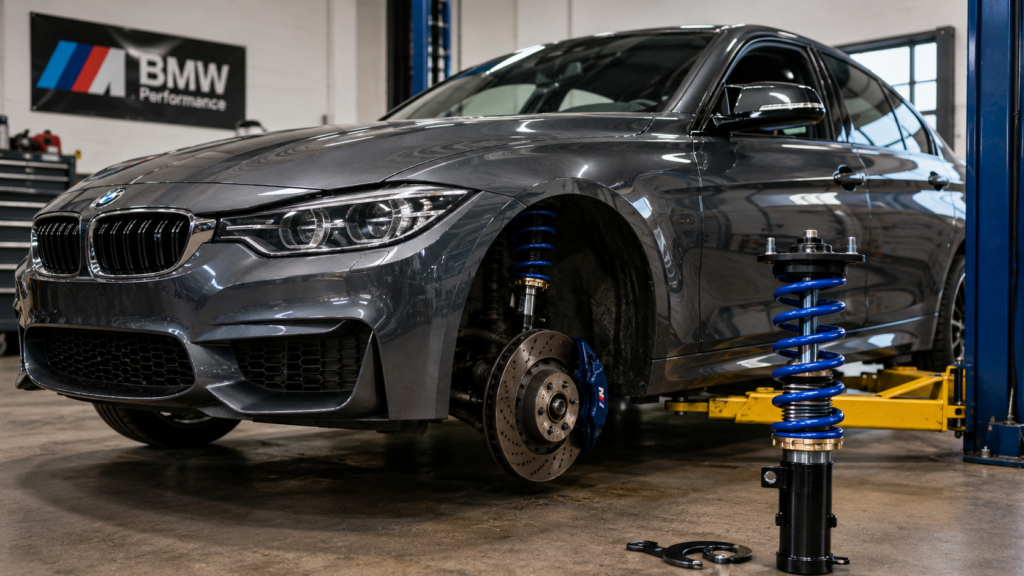
BMW coilovers give you much more control over ride height and suspension behavior than lowering springs alone. But that adjustability also makes it possible to build a setup that looks great in photos and drives worse on the street.
For a daily-driven or mostly street-driven BMW, the goal usually should not be to go as low or as stiff as possible. A better setup improves body control, reduces wheel gap, sharpens handling and still keeps enough suspension travel and ride quality to enjoy the car every day.
This guide covers what BMW owners should know before buying coilovers, including ride quality, lowering, adjustable damping, EDC and adaptive suspension, xDrive fitment, alignment, cost and the tradeoffs compared with lowering springs.
What Are Coilovers on a BMW?
A coilover combines the spring and damper into an integrated suspension assembly. Most aftermarket BMW coilover kits also use a threaded body or adjustable spring perch that lets you change ride height within the manufacturer’s designed adjustment range.
Depending on the kit, you may also be able to adjust damping. More advanced systems provide additional control over suspension behavior, while simpler street-oriented coilovers may have fixed damping and focus primarily on ride-height adjustment.
That flexibility is the main reason enthusiasts choose coilovers. Instead of accepting the fixed drop of a lowering spring, you can set the stance more precisely and use a spring-and-damper package engineered to work together.
| Suspension Setup | Ride Height | Damping | Best Fit |
|---|---|---|---|
| Factory suspension | Fixed | Factory calibrated | Comfort and simplicity |
| Lowering springs | Fixed drop | Depends on dampers used | Moderate lowering on a budget |
| Basic coilovers | Adjustable | Usually fixed or limited adjustment | Owners prioritizing height control |
| Adjustable coilovers | Adjustable | Adjustable | Street enthusiasts wanting more tuning control |
Are Coilovers Good for a Daily-Driven BMW?
They can be. A properly selected and properly adjusted coilover kit can work very well on a daily-driven BMW.
The important point is that coilovers are not automatically better simply because they are adjustable. A low-quality kit, overly aggressive spring rates, excessive lowering or poor damping can make a BMW less comfortable and less composed on real roads.
For street use, prioritize:
- Quality damping instead of maximum stiffness
- Enough suspension travel for rough pavement
- A moderate ride height rather than the lowest possible setting
- Spring rates appropriate for street use
- Correct fitment for the exact chassis and drivetrain
- EDC or adaptive-suspension compatibility when applicable
- Adjustment features you will actually use
A street car spends far more time dealing with potholes, expansion joints, uneven pavement and highway driving than attacking a smooth racetrack. The suspension should be selected accordingly.
BMW Coilover Ride Quality: Will They Make the Car Harsh?
Coilovers usually make suspension behavior firmer and more controlled than the standard BMW suspension, but they do not automatically make the car unbearably harsh.
Ride quality depends on the complete setup: spring rate, damper tuning, available suspension travel, tire sidewall, wheel size, ride height and the condition of surrounding suspension components all matter.
A well-damped suspension can feel firm without feeling crude. A poorly matched setup can bounce, crash over sharp impacts or feel unsettled even when the springs themselves are not exceptionally stiff.
This is why buying coilovers based only on how low they go or how many adjustment settings they advertise can be a mistake. More adjustment does not automatically mean better ride quality.
How Low Should You Set BMW Coilovers?
For a street BMW, usually not as low as the hardware physically allows.
Lowering the center of gravity can reduce some body movement, but excessive lowering also reduces available suspension travel and can introduce clearance and alignment problems. The lowest setting is not necessarily the best-handling setting.
A moderate drop that removes excessive wheel gap while preserving useful suspension travel is generally the better choice for a street-driven car.
Before setting ride height, consider:
- Driveway and parking-garage clearance
- Speed bumps
- Front bumper and undertray clearance
- Wheel and tire fitment
- Fender clearance under compression
- Alignment range
- Winter driving if the BMW is used year-round
Stay within the coilover manufacturer’s approved ride-height range rather than trying to force the car below the range the dampers were designed around.
Do You Need Adjustable Damping?
Not everyone does.
Fixed-damping coilovers can work extremely well when the manufacturer has already matched the spring and damper rates for the intended application. They also remove the temptation to constantly change settings without knowing whether the adjustment is actually improving the car.
Adjustable damping becomes more useful when you want to fine-tune the balance between comfort and body control or use the same BMW for both street driving and occasional performance driving.
| Type | Advantages | Tradeoffs |
|---|---|---|
| Fixed damping | Simpler, usually cheaper, already calibrated | Less ability to fine-tune ride |
| Single adjustable | More tuning flexibility without excessive complexity | Requires some experimentation |
| Multi-adjustable | Greater control for advanced setups | Higher cost and easier to misadjust |
For most street-driven BMWs, having the right damping is more important than having the largest number of adjustment settings.
Popular BMW Coilover Brands to Consider
There is no single best BMW coilover brand for every chassis, budget and driving style. Fitment and the specific kit matter more than the logo on the box. Still, several manufacturers regularly appear on BMW owners’ shopping lists.
Bilstein Coilovers
Bilstein is a long-established suspension manufacturer and a strong place to start if you want a street-oriented setup from a company known for dampers as well as complete coilover systems. Depending on the BMW application, Bilstein offers different levels of ride-height and damping capability.
KW Coilovers
KW offers a broad range of BMW suspension systems, including street-focused and more adjustable options. They are worth comparing if you want a premium setup and are willing to spend more for additional suspension refinement or adjustment capability.
BC Racing Coilovers
BC Racing is another common option for BMW enthusiasts, particularly owners looking for adjustable coilovers without immediately moving into the highest premium price tiers. As always, compare the exact application, spring rates and intended use rather than buying by price alone.
If you are not committed to a particular brand yet, it is usually smarter to start with your exact BMW fitment and compare the available systems side by side.
BMW Coilovers With EDC or Adaptive Suspension
If your BMW has Electronic Damper Control (EDC) or an adaptive suspension system, check compatibility before buying anything.
Replacing electronically controlled factory dampers with conventional coilovers can create suspension warnings unless the factory system is handled correctly.
Depending on the BMW and coilover kit, you may encounter several approaches:
- Electronically compatible coilovers: designed to work with the vehicle’s electronic damping system.
- Conventional coilovers with an EDC cancellation solution: replace the adaptive dampers while preventing suspension fault messages.
- Conventional systems requiring another coding or cancellation method: compatibility depends on the chassis and kit.
Do not assume two coilover kits for the same BMW model are interchangeable if one car has adaptive suspension and the other does not.
Checking the exact vehicle equipment and manufacturer fitment notes before ordering can prevent a very expensive mistake.
What About xDrive BMWs?
xDrive is another reason to buy by exact application rather than assuming a kit fits every version of a chassis.
Some manufacturers use different coilover part numbers or specifications for rear-wheel-drive and xDrive BMWs. Front suspension packaging, vehicle weight and drivetrain components can affect compatibility.
If you own an xDrive BMW, verify that the exact kit is approved for your drivetrain and stay within its specified lowering range.
BMW Coilover Spring Rates: Stiffer Is Not Always Better
One of the easiest mistakes to make when comparing coilovers is assuming that a higher spring rate automatically means better handling.
The spring and damper need to work together, and the suspension needs to match the road surface and intended use of the car.
A very stiff suspension may reduce body movement on smooth pavement but struggle to keep the tires composed over rough or uneven surfaces. On a street car, that can hurt both comfort and usable grip.
Unless you are building a BMW for a very specific motorsport purpose, it usually makes more sense to choose a reputable kit engineered around your chassis and intended use than to shop based on spring-rate numbers alone.
BMW Coilovers vs Lowering Springs
Lowering springs and coilovers can both reduce ride height, but they solve different problems.
| Feature | Coilovers | Lowering Springs |
|---|---|---|
| Ride-height adjustment | Yes | No — fixed drop |
| Matched dampers included | Yes | Usually no |
| Damping adjustment | Available on some kits | No |
| Initial cost | Higher | Lower |
| Setup flexibility | High | Low |
| Best for | Owners wanting a complete adjustable suspension | Owners wanting a simpler moderate drop |
If you simply want to reduce wheel gap and sharpen the appearance of a street BMW without needing ride-height or damping adjustment, lowering springs may be enough.
If that sounds closer to your goal, see our BMW lowering springs guide for the ride-quality, drop, damper, fitment, and alignment considerations to understand before choosing a spring kit.
If you want to control ride height precisely, replace the springs and dampers as a matched system, or tune the suspension more extensively, coilovers make more sense.
For a broader look at how coilovers, lowering springs and sway bars fit together, see our BMW Suspension Upgrades guide.
How Much Do BMW Coilovers Cost?
BMW coilover prices vary considerably depending on the chassis, construction, damping technology and level of adjustability.
| General Price Range | What You Typically Get |
|---|---|
| Under about $1,000 | Entry-level systems with fewer premium features |
| About $1,000–$1,500 | Many enthusiast-oriented street coilovers |
| About $1,500–$2,500 | Higher-end damping, construction and adjustment options |
| $2,500–$3,500+ | Premium street/track systems or advanced damping technology |
Those numbers are for the parts themselves. Professional installation, an alignment and any worn mounts, bushings or other suspension components discovered during the job can add to the total cost.
Price also varies substantially between BMW platforms, so use these ranges as a shopping framework rather than a quote for a specific vehicle.
Do You Need an Alignment After Installing Coilovers?
Yes. Plan on an alignment after installing BMW coilovers.
Changing ride height changes suspension geometry. Toe and camber can move away from their previous settings, affecting steering behavior, stability and tire wear.
Set the final ride height first, make sure the suspension is properly installed and seated, then have the BMW aligned for the way it will actually be driven.
If you later make a significant ride-height change, check the alignment again.
Popular BMW Chassis for Coilovers
Coilovers are available for a huge range of BMW platforms, but fitment should always be confirmed by chassis, drivetrain and suspension configuration.
| BMW Chassis | What to Check Before Buying |
|---|---|
| E46 | Age of mounts, bushings and surrounding suspension components |
| E90 / E92 | Exact chassis and drivetrain fitment |
| F30 / F31 | RWD vs xDrive and EDC/adaptive suspension |
| G20 | Exact model, drivetrain and adaptive-suspension compatibility |
| BMW SUVs / SAVs | Chassis-specific lowering range, weight and drivetrain fitment |
Older BMWs deserve special attention because installing new coilovers does not renew every other suspension component. Worn control-arm bushings, mounts, links or ball joints can still create noise and poor handling even with brand-new springs and dampers.
If you’re modifying an M3, suspension should be considered alongside the rest of the build rather than in isolation. See our BMW M3 mods guide for generation-specific upgrade priorities for the E92, F80 and G80.
What to Look for Before Buying BMW Coilovers
For a street-driven BMW, use this order rather than shopping by brand name alone:
- Confirm exact fitment. Check chassis, drivetrain and EDC/adaptive suspension.
- Decide how the car will actually be used. Daily driving and occasional spirited driving require a different compromise than a track-focused build.
- Choose a realistic ride height. Do not buy a kit purely because it advertises the largest possible drop.
- Decide whether damping adjustment matters. Paying for adjustment only makes sense if you need or will use it.
- Prioritize damper quality. Good control matters more than simply making the suspension stiff.
- Budget for installation and alignment. The coilover kit is not necessarily the entire cost of the job.
- Inspect the rest of the suspension. Especially on older BMWs, worn components should be addressed rather than hidden behind new coilovers.
Are BMW Coilovers Worth It?
BMW coilovers are worth considering when you want more than a simple cosmetic drop.
They make the most sense if you want a matched spring-and-damper package, adjustable ride height, firmer body control or the ability to tune the suspension beyond what lowering springs provide.
They make less sense if your only goal is to remove a small amount of wheel gap and you are completely satisfied with the way the factory suspension drives.
For most street BMWs, a quality street-oriented coilover installed at a sensible height is a better choice than the cheapest possible kit set as low and stiff as possible.
The best setup is the one that improves the BMW you actually drive—not the one with the most aggressive specification sheet.
BMW Coilovers FAQ
Do coilovers make a BMW ride rough?
Usually firmer, but not necessarily excessively rough. Ride quality depends on damper tuning, spring rates, ride height, suspension travel, wheels and tires. A quality street-oriented coilover at a sensible height can remain comfortable enough for daily use.
Are coilovers better than lowering springs on a BMW?
Coilovers offer more control because they normally include matched dampers and adjustable ride height. Lowering springs are cheaper and simpler if you only want a fixed moderate drop. Neither option is automatically better for every BMW owner.
Do BMW coilovers need an alignment?
Yes. Installing coilovers and changing ride height alters suspension geometry, so the BMW should be aligned after the final ride height is established.
Can you install coilovers on a BMW with adaptive suspension?
Yes, but you need a kit designed for the vehicle’s suspension configuration or an appropriate solution for the factory electronic dampers. Some systems retain electronic damping while conventional kits may require an EDC cancellation solution.
How much should I spend on BMW coilovers?
There is no single correct budget. Enthusiast street kits commonly start around the $1,000 range, while premium systems can exceed $3,000. Fitment, damper quality and the features you actually need matter more than buying solely by price.
How low should I lower my BMW on coilovers?
For a street car, use a moderate drop that improves appearance and handling while retaining useful suspension travel and ground clearance. Stay within the coilover manufacturer’s specified adjustment range.