Best S55 Downpipes for F80 M3, F82 M4 & M2 Competition
This post may contain affiliate links. If you buy through one of our links, we may earn a commission at no extra cost to you.
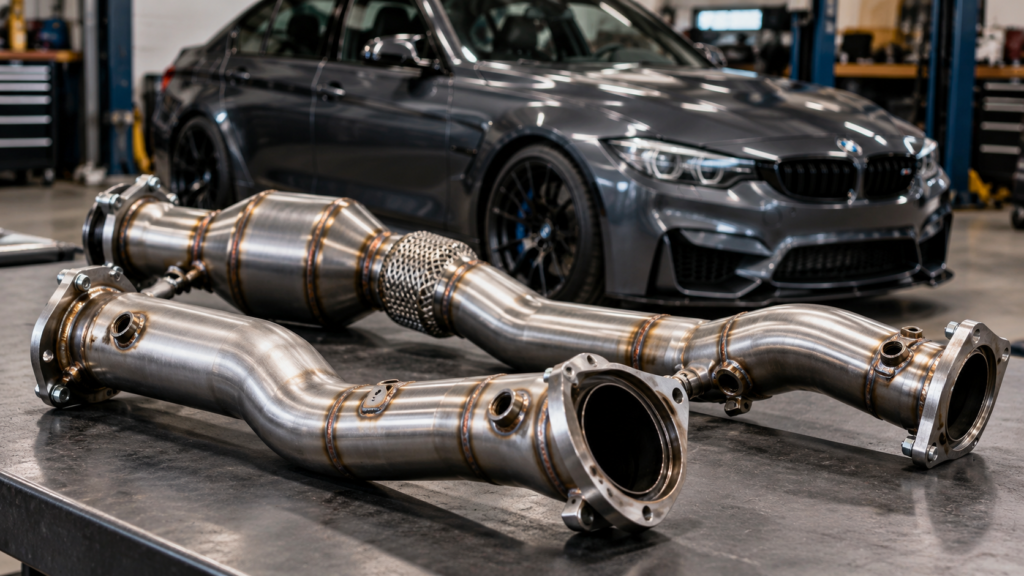
An S55 downpipe upgrade is one of the more involved exhaust modifications you can consider for a BMW F80 M3, F82/F83 M4 or F87 M2 Competition. Unlike a rear exhaust change, downpipes sit close to the turbochargers and catalytic converters, so the decision affects exhaust flow, sound, emissions equipment and possibly check-engine-light behavior.
This guide compares four catted S55 downpipe options currently listed by Turner Motorsport: CTS Turbo, Racing Dynamics, Wagner Tuning and Active Autowerke. We’ll focus on what each product actually offers, where the price differences come from, and what to verify before spending money. These are researched comparisons, not claims of hands-on testing.
Best S55 Downpipes at a Glance
| Downpipe | Catalyst Design | Listed Price* | Best Fit |
|---|---|---|---|
| CTS Turbo | High-flow catted; cell count not specified in Turner listing | $599.99 | Lowest upfront price |
| Racing Dynamics | 200-cell sport catalyst | $1,390 | Midrange choice with heat shielding |
| Wagner Tuning | 200 CPSI metal sport catalyst | $2,290 | Higher-end 200-cell design |
| Active Autowerke | 400-cell GESI high-flow catalyst | $2,849.99 | Owners prioritizing the manufacturer’s emissions and no-CEL claims |
Our short answer: CTS is the budget-conscious starting point if you understand its tuning and CEL warning. Racing Dynamics is the more balanced mid-price comparison. Wagner targets buyers specifically interested in a premium 200-cell metal-cat design. Active Autowerke has the clearest stated no-CEL positioning, but costs substantially more and its claims do not establish legal approval for every road vehicle or state.
S55 Downpipe Fitment: F80 M3, F82 M4 and M2 Competition
All four featured Turner listings include these S55-powered BMWs in their fitment information:
- F80 M3: S55 twin-turbo inline-six
- F82 M4: S55 twin-turbo inline-six coupe
- F83 M4: S55 twin-turbo inline-six convertible
- F87 M2 Competition: S55 twin-turbo inline-six
Do not confuse the F87 M2 Competition with the original F87 M2. The regular M2 uses the N55 engine and needs a different downpipe. Likewise, the E9x M3 uses the S65 V8 and the G80/G82 M3/M4 use the S58. None of those should be treated as S55-fitment applications. Always confirm your exact year, chassis and engine in the retailer’s vehicle selector before ordering.
If you’re planning several upgrades rather than just a downpipe, start with our BMW M3 mods guide, which separates E9x, F80 and G80 recommendations by generation.
Four Catted S55 Downpipes Compared
1. CTS Turbo High-Flow Catted Downpipes — Lowest Upfront Price
Best for: An S55 owner comparing affordable performance-oriented hardware who is prepared to evaluate tuning, warning-light and emissions implications before installation.
The CTS Turbo option is the least expensive product in this comparison. Turner lists a 3-inch stainless-steel design, high-flow catalytic converters, factory-style oxygen-sensor placement, and compatibility with factory midpipes. CTS positions it as a flow and sound upgrade, particularly when paired with suitable software.
The catch is significant: the CTS listing warns that a check-engine light will illuminate without its specified software configuration. That makes this a poor assumption-based purchase for a daily driver that must retain its original emissions-monitoring behavior. Modifying software to defeat emissions diagnostics can also raise legal issues.
- Strengths: Lowest listed price, 3-inch stainless construction, OEM-midpipe compatibility
- Tradeoffs: Explicit CEL/software warning; no verified emissions approval for every street application
- Turner part reference: T#14254799
2. Racing Dynamics 200-Cell Downpipes — Midrange Option
Best for: Buyers who want to compare a purpose-built 200-cell catted option without moving straight to the highest-priced products.
Racing Dynamics lists 200-cell sport catalysts, stainless-steel construction and heat shielding intended to reduce heat exposure around the installation area. The listed price sits well above CTS but below Wagner and Active Autowerke.
The heat-shielding detail is worth considering on a crowded twin-turbo engine. However, a 200-cell rating on its own tells you neither how much horsepower a downpipe will add nor whether it will meet your area’s emissions rules. Turner does not make the same prominent no-CEL promise here that Active Autowerke makes, so do not assume a warning-free result.
- Strengths: Identified 200-cell catalyst, stainless construction, heat shielding, midrange listed price
- Tradeoffs: No independently established power or CEL outcome for your specific car; verify emissions restrictions
- Turner part reference: T#638274
3. Wagner Tuning 200-Cell Downpipe — Premium Metal-Cat Design
Best for: Buyers specifically seeking Wagner’s 200 CPSI metal-catalyst construction and willing to pay more for that design.
Wagner Tuning’s S55 offering uses a 200 CPSI metal sport catalyst and stainless-steel construction. Turner describes it as a reduced-restriction replacement intended to improve exhaust flow near the turbochargers.
At its listed price, Wagner needs a more specific justification than simply wanting more sound. The retailer also states that special software may be needed to avoid emissions-related faults and check-engine lights. A higher price does not eliminate that issue, and the 200-cell construction does not by itself prove street legality.
- Strengths: Clearly specified 200 CPSI metal catalyst and stainless construction
- Tradeoffs: High listed price; retailer identifies possible software and CEL implications
- Turner part reference: T#587590
4. Active Autowerke High-Flow GESI Downpipes — Premium Emissions-Focused Claim
Best for: Owners comparing a high-flow catted design with a manufacturer-stated focus on catalyst efficiency and avoiding a check-engine light.
Active Autowerke’s S55 product uses a 400-cell GESI high-flow catalyst and TIG-welded 304 stainless-steel construction. Its listing highlights fast catalyst light-off, OEM oxygen-sensor heat-shield compatibility and a manufacturer-stated “no CEL” feature. It also advertises a 5-year/50,000-mile catalytic-converter warranty.
That positioning may explain its premium price, but it needs careful interpretation. An advertised no-CEL result is not a guarantee for every modified car. Likewise, an EPA-registered catalyst or a retailer’s EPA-compliance statement should not be treated as blanket approval for installation on every S55 vehicle in every state. Turner explicitly excludes California pollution-controlled vehicles; verify the product’s current application-specific legal status before ordering.
- Strengths: 400-cell GESI catalyst, stated no-CEL design, detailed construction claims and published catalyst warranty
- Tradeoffs: Highest price in this comparison; no universal guarantee of legality or fault-free operation
- Turner part reference: T#2393422
Catted vs. Catless S55 Downpipes: What Matters?
Catted downpipes retain a catalytic converter, but high-flow designs can still alter how the vehicle’s factory emissions system operates. Catless pipes remove that catalyst from the modified section entirely, increasing the risk of emissions violations, exhaust odor and diagnostic faults. For a car originally certified for road use, do not assume “track use” or occasional off-road driving automatically makes removal of required emissions equipment legal.
All four featured products are marketed as catted. Their 200-cell versus 400-cell descriptions refer to catalyst substrate density, not a direct horsepower ranking or proof of compliance. Catalyst formulation, size, construction, temperature behavior and vehicle-specific testing matter too.
For a broader explanation of downpipes versus other BMW exhaust changes, see our BMW downpipes guide and BMW exhaust upgrades comparison.
Do S55 Downpipes Add Horsepower or Change the Sound?
Lower-restriction downpipes can support improved exhaust flow on a turbocharged S55, potentially changing turbo response and exhaust character. But there is no single honest horsepower figure for every F80, F82 or M2 Competition. Results depend on the exact parts, existing exhaust, engine calibration, fuel, testing method and condition of the car.
Expect sound to be affected, especially during acceleration and cold starts. The final result depends on the midpipe, rear exhaust and valves as well as the downpipes. If the main goal is more sound without dealing with emissions-related hardware, consider a cat-back or rear-section exhaust first.
Will an S55 Downpipe Cause a Check Engine Light or Need a Tune?
It can. Downpipes sit in a part of the exhaust system monitored by oxygen sensors and catalyst-efficiency diagnostics. Changing catalyst performance may produce an emissions-related fault even when the hardware physically fits.
- CTS Turbo: Its listing explicitly warns of a CEL without the specified software configuration.
- Wagner Tuning: Turner warns that software may be necessary to avoid emissions faults.
- Racing Dynamics: Do not assume CEL-free operation without confirmation for the exact installation.
- Active Autowerke: Advertises no-CEL operation, but actual results and legal status still require verification.
Software that disables emissions monitoring is not a proper substitute for a compliant repair or installation. If a warning light appears, diagnose the code rather than simply hiding it. Our BMW diagnostic tool guide explains how to choose a scanner that can read relevant faults.
Are Aftermarket S55 Downpipes Street Legal?
Not automatically. Under U.S. anti-tampering rules, replacing or altering an emissions-control component can be prohibited when it reduces required emissions-control effectiveness. State rules and inspection requirements can be stricter. A product being “catted,” “high-flow,” or marketed with EPA-related language does not by itself establish that it is approved for your exact model year and location.
Before purchase, check the seller’s restrictions, ask for application-specific documentation from the manufacturer, and confirm what your local inspection program allows. You can review the EPA’s vehicle tampering policy for the federal framework. If your daily driver must pass emissions testing, retaining the OEM emissions system may be the more practical choice.
What to Check Before Ordering an F80 M3 or F82 M4 Downpipe
- Engine and chassis: Confirm S55 fitment for your F80 M3, F82/F83 M4 or F87 M2 Competition. Do not order based on the M badge alone.
- Included components: Confirm whether the listing contains all required pipes, gaskets, clamps and hardware. Product titles sometimes use singular and plural inconsistently.
- Midpipe compatibility: Verify fitment with your factory or aftermarket exhaust configuration.
- CEL and software claims: Read the exact product notes, and do not assume software changes are legal or suitable for a street vehicle.
- Emissions and inspection: Check documentation for your vehicle application and state before committing.
- Labor and serviceability: Allow for difficult access around the turbochargers, seized fasteners, sensor removal and possible exhaust leaks. Consider a BMW-experienced installer.
Is an S55 Downpipe Worth It for a Daily Driver?
For most street-driven S55 cars, a downpipe should be a deliberate later modification, not an automatic first purchase. Tires, proper maintenance and a well-chosen rear exhaust can improve your day-to-day experience with fewer complications. The value case for downpipes becomes stronger when you have a specific performance objective, understand the emissions implications, and have verified the rest of the setup.
If you’re mostly after sound, start with the cat-back versus downpipe comparison before spending on hardware nearest the turbos.
S55 Downpipe FAQ
What is the best S55 downpipe for the F80 M3?
It depends on priorities. CTS has the lowest listed price but a clear CEL/software warning. Racing Dynamics offers a midrange 200-cell design with heat shielding. Wagner is a higher-priced 200-cell option, while Active Autowerke emphasizes its GESI catalyst and manufacturer-stated no-CEL behavior. First confirm emissions suitability for your car.
Are F80 M3 and F82 M4 downpipes the same?
Many S55 downpipe listings cover both chassis, and the four products here list F80 M3 and F82 M4 fitment. Do not treat that as blanket interchangeability for every aftermarket part: confirm the retailer’s fitment information for the exact vehicle.
Do S55 downpipes fit the regular F87 M2?
No. The original F87 M2 uses the N55 engine, while the F87 M2 Competition uses the S55. These S55 products are for the M2 Competition, not the N55-powered regular M2.
Do catted downpipes guarantee no check engine light?
No. A high-flow catalyst can still behave differently from the original emissions equipment. Some manufacturers advertise no-CEL behavior, but the result depends on the exact product, installation and car.
Should I buy an S55 downpipe just for sound?
Usually not as the first step. For a daily driver where sound is the main goal, a rear exhaust or cat-back system is generally a more straightforward place to start because it avoids replacing hardware so close to the catalytic converters and emissions sensors.
Final Recommendation: Which S55 Downpipe Should You Choose?
Best budget comparison: CTS Turbo, provided you understand and can legally address its installation and CEL limitations. Best midrange comparison: Racing Dynamics, for its listed 200-cell setup and heat shielding. Premium 200-cell choice: Wagner Tuning. Premium catalyst-and-CEL-focused choice: Active Autowerke, with its stated GESI and no-CEL features—but without assuming blanket street legality.
There is no universal winner for every S55 owner. The correct fit is the product that matches your car, budget, intended use and actual emissions requirements. If those requirements are not settled, keep the OEM catalyst and solve that question before buying an upgrade.