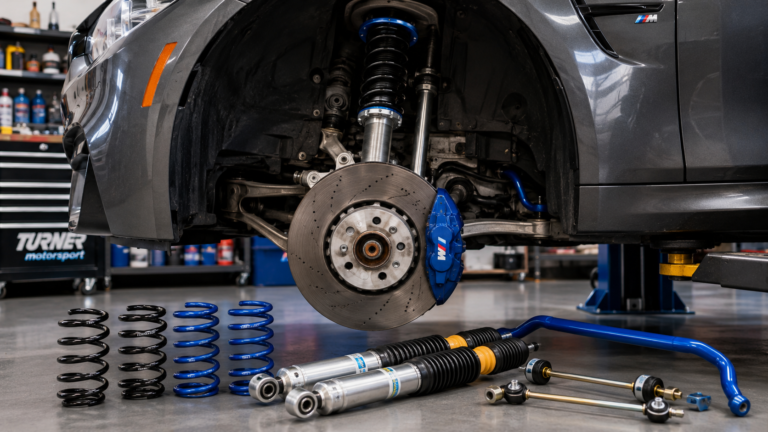
BMW Lowering Springs: Ride Quality, Drop, Pros & Cons
This post may contain affiliate links. If you buy through one of our links, we may earn a commission at no extra cost to you.
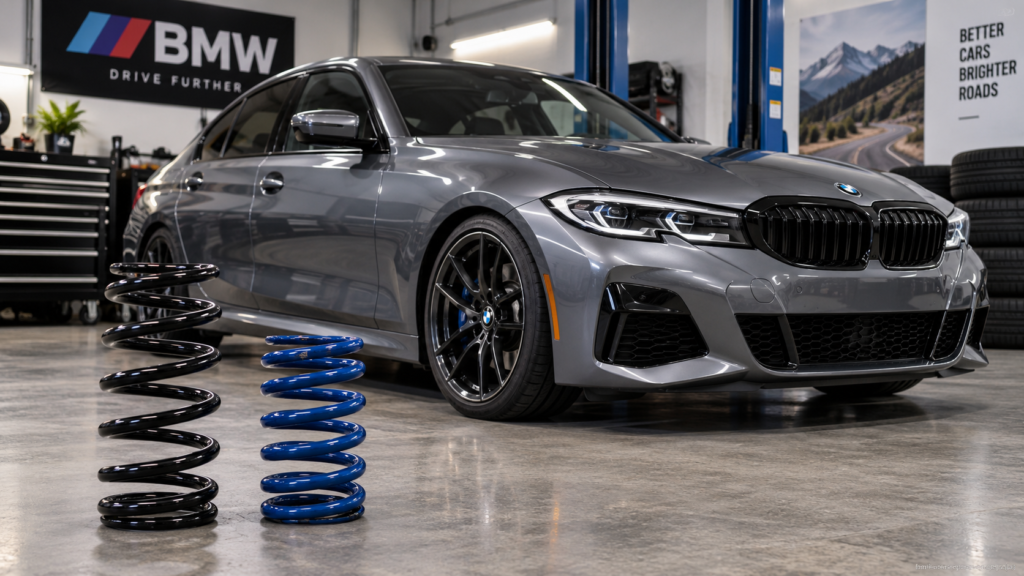
BMW lowering springs are one of the simplest ways to reduce wheel gap, lower the center of gravity and give a street-driven BMW a more aggressive stance without moving to a full coilover suspension.
But lowering springs are not just a cosmetic modification. Shorter and usually firmer springs change how the suspension moves, how much travel is available and how the car responds to bumps, corners and braking.
The right setup can make a BMW feel tighter and look noticeably better while remaining comfortable enough for daily use. The wrong springs—or an overly aggressive drop—can create a harsh ride, reduced suspension travel, alignment problems or worn-out dampers.
This guide covers the important tradeoffs before buying BMW lowering springs, including ride quality, drop amount, handling, factory dampers, adaptive suspension, xDrive, alignment and how lowering springs compare with coilovers.
What Do Lowering Springs Do on a BMW?
Lowering springs replace the factory coil springs with shorter springs designed to reduce ride height. Most performance lowering springs also use different spring rates from the original BMW springs to better control body movement with the reduced suspension travel.
The most noticeable change is visual: the space between the tires and wheel arches becomes smaller. But lowering the car can also reduce body roll, squat and dive and make steering response feel more immediate.
Unlike coilovers, conventional lowering springs provide a fixed drop. Once installed, you cannot turn an adjuster and raise or lower the car.
| Setup | Ride Height | Dampers | Typical Reason to Choose It |
|---|---|---|---|
| Factory suspension | Stock | Factory | Comfort and simplicity |
| Lowering springs | Fixed lower height | Factory or upgraded dampers | Moderate drop with lower cost |
| Coilovers | Adjustable | Included as part of system | Greater height and suspension control |
Are BMW Lowering Springs Good for Daily Driving?
Yes, provided the springs are designed for the exact BMW and the drop is sensible for street use.
A mild or moderate lowering spring can be one of the better suspension modifications for an owner who wants improved stance and slightly tighter handling without the cost or complexity of adjustable coilovers.
For a daily driver, look for a setup that prioritizes:
- A moderate rather than extreme drop
- Spring rates intended for street use
- Compatibility with your exact BMW chassis and suspension
- Enough remaining suspension travel for rough roads
- Reasonable ground clearance
- Compatibility with your wheels and tires
- Good-quality dampers in usable condition
Going lower simply because another spring advertises a larger drop usually is not the best way to build a street BMW.
BMW Lowering Springs Ride Quality: How Much Firmer Will It Feel?
Expect some change in ride quality.
Lowering springs generally need to control the car within less suspension travel than the factory springs, so they commonly feel firmer. How noticeable that difference becomes depends on the spring design, drop amount, dampers, wheel size, tire sidewall and the roads you drive on.
A mild street-oriented spring setup can still be very livable. Sharp pavement seams and potholes may feel more pronounced, but the car can also feel more controlled during turns, braking and quick direction changes.
The ride tends to become more compromised when you combine several aggressive changes at once, such as:
- A large drop
- Very stiff springs
- Worn factory dampers
- Large wheels with low-profile tires
- High tire pressures
- Little remaining suspension travel
If comfort matters, choose the complete setup rather than judging springs only by how much wheel gap they remove.
How Much Should You Lower a Street BMW?
There is no single perfect drop for every BMW because factory ride height, chassis design, wheel fitment and suspension options vary.
For most street cars, the useful goal is a moderate drop that reduces wheel gap without sacrificing too much suspension travel or ground clearance.
Before choosing the lowest spring available, think about:
- Speed bumps
- Steep driveways
- Parking garages
- Front bumper and underbody clearance
- Wheel and tire width
- Fender clearance under suspension compression
- Snow and winter driving
- Alignment range
The advertised drop should also be treated as a guide rather than a guarantee. Actual ride-height change can vary with the BMW’s factory suspension package, drivetrain, vehicle weight and existing spring setup.
Popular BMW Lowering Spring Brands
BMW owners have several established lowering spring brands to choose from. There is no universal winner because the best choice depends on the exact chassis, desired drop and how much ride-quality compromise you are willing to accept.
H&R Lowering Springs
H&R offers a large range of BMW lowering spring applications and is a common choice for owners looking for a sportier stance and firmer street handling. Different H&R product lines and BMW applications can provide different amounts of lowering, so check the exact part rather than assuming every H&R spring has the same drop.
H&R makes particular sense to compare if you want a more performance-oriented street setup while still keeping the simplicity of fixed-height springs.
Dinan Lowering Springs
Dinan’s BMW suspension products generally appeal to owners looking for a more conservative street-performance approach rather than simply maximizing the drop.
Some Dinan applications also have complementary suspension components intended to work with the lowering springs, so check the full recommended setup for your BMW rather than assuming the spring set is the only available part.
Dinan is especially worth considering if preserving everyday drivability is high on your priority list.
Eibach Lowering Springs
Eibach is another established suspension manufacturer with BMW applications aimed at owners who want improved stance and handling without automatically moving to a full coilover system.
The exact amount of lowering and suspension behavior varies by application, so compare the specific Eibach kit for your chassis, drivetrain and factory suspension rather than relying on a generic brand comparison.
If you are not committed to a particular manufacturer, start with your exact BMW fitment and compare the available spring sets by drop, intended use and suspension compatibility.
Can You Use Lowering Springs With Factory BMW Shocks and Struts?
Sometimes, but this needs more thought than simply asking whether the parts physically fit.
Many mild lowering spring kits are designed to work with factory-style dampers, particularly when those dampers are still in good condition. However, shorter and firmer springs change the operating conditions of the shock or strut.
On a newer, lower-mileage BMW with a modest spring drop, retaining the factory dampers may be reasonable if the spring manufacturer approves the combination.
On a higher-mileage BMW, installing lowering springs on tired original dampers can be false economy. You are already paying for much of the same suspension labor, and worn dampers can leave the car bouncing or poorly controlled even though the springs are new.
Before installation, inspect the shocks or struts, mounts, bump stops and surrounding suspension components.
What About Bump Stops and Suspension Travel?
Suspension travel matters on a lowered BMW.
As ride height decreases, the suspension has less room to compress before reaching the limits of its available travel. If the setup spends too much time contacting the bump stops, the ride can become noticeably harsher and the car may feel unsettled over rough pavement.
This is one reason an intelligently designed moderate drop can work better on the street than an extreme one.
Follow the spring manufacturer’s instructions regarding bump stops and any supplemental suspension hardware. Do not automatically cut, remove or modify bump stops unless the manufacturer specifically calls for it.
BMW Lowering Springs With Adaptive Suspension or EDC
Lowering springs can often be used on BMWs with adaptive or electronically controlled dampers, but compatibility is application-specific.
Unlike conventional coilovers that may replace the factory electronic dampers entirely, a spring-only setup can sometimes retain the adaptive dampers and their factory electronic functionality.
That does not mean every spring fits every adaptive-suspension BMW. The spring needs to be approved for the exact chassis and suspension configuration.
Before ordering, confirm:
- Exact chassis and model
- Rear-wheel drive or xDrive
- Standard, M Sport or adaptive suspension
- Any manufacturer-specific installation requirements
If retaining the factory electronic suspension is important to you, lowering springs can be an attractive alternative to replacing the entire system with conventional coilovers.
BMW Lowering Springs on xDrive Models
xDrive fitment should always be verified separately.
A lowering spring marketed for a rear-wheel-drive version of a BMW should not automatically be assumed to fit the xDrive version of the same model. Vehicle weight, suspension packaging and manufacturer specifications can differ.
Use the exact application listed by the spring manufacturer or retailer, and avoid choosing a kit based only on the model badge.
Do Lowering Springs Improve BMW Handling?
They can improve several aspects of how a BMW feels, particularly when the spring rates and dampers work well together.
Potential changes include:
- Reduced body roll
- Less squat under acceleration
- Less dive under braking
- Quicker-feeling initial response
- A more planted sensation during transitions
But lower and stiffer do not automatically equal more grip.
A suspension still needs enough movement to keep the tires in contact with uneven pavement. Excessive stiffness or insufficient travel can make a street car skip or lose composure over rough surfaces.
For daily driving, balance is more useful than chasing maximum stiffness.
BMW Lowering Springs vs Coilovers
This is usually the biggest decision once you know you want to lower the car.
| Feature | Lowering Springs | Coilovers |
|---|---|---|
| Ride height | Fixed | Adjustable |
| Dampers included | No | Yes |
| Damping adjustment | No | Available on some kits |
| Initial parts cost | Lower | Higher |
| Setup complexity | Lower | Higher |
| Best for | Simple moderate street drop | Owners wanting more suspension control |
Choose lowering springs if you mainly want a tasteful fixed drop, improved stance and somewhat firmer handling without needing suspension adjustment.
Choose coilovers if you want precise ride-height control, matched replacement dampers, adjustable damping on some systems or greater flexibility for a more serious suspension build.
If you are considering the adjustable route, read our BMW coilovers guide for a deeper look at ride quality, cost, EDC compatibility, spring rates and street-car setup.
Do You Need an Alignment After Installing BMW Lowering Springs?
Yes. Plan on having the BMW aligned after the springs are installed.
Lowering changes suspension geometry. Toe and camber can shift from their previous settings, which can affect steering behavior and tire wear.
After installation, allow the suspension to be properly assembled and seated, then have the alignment checked at the car’s new ride height.
Owners using aggressive wheel and tire fitments should be particularly attentive to alignment and clearance after lowering the car.
How Much Does It Cost to Install BMW Lowering Springs?
The spring set is only part of the total cost.
Your final cost can include:
- The lowering springs
- Professional installation if you are not doing the work yourself
- Alignment
- Replacement mounts or bump stops
- New shocks or struts if the existing dampers are worn
- Other worn suspension components discovered during installation
Labor varies considerably by BMW chassis and local shop rates, so compare the complete installed cost rather than deciding based only on the spring price.
If your dampers are already near the end of their life, the total cost of springs plus replacement dampers can also narrow the price gap between lowering springs and an entry-level coilover system.
BMW Lowering Springs: Pros and Cons
| Pros | Cons |
|---|---|
| Lower cost than most coilover systems | Ride height is not adjustable |
| Reduces wheel gap | Usually firms up ride quality |
| Can improve body control | Reduces available suspension travel |
| Simple compared with a fully adjustable suspension | Factory dampers may wear or perform poorly if already tired |
| Can retain factory adaptive dampers on compatible applications | Alignment is still required after installation |
| Good option for a mild street build | An aggressive drop can create clearance problems |
What to Check Before Buying BMW Lowering Springs
Use this checklist before ordering:
- Confirm exact BMW fitment. Model name alone is not enough.
- Check the advertised drop for your application. Do not assume every spring from one brand lowers every BMW by the same amount.
- Identify your factory suspension. Standard, M Sport and adaptive configurations can matter.
- Verify xDrive compatibility. Use the exact spring set intended for your drivetrain.
- Inspect the existing dampers. Installing new springs on worn shocks or struts can produce poor results.
- Consider wheel and tire clearance. Especially if the car already has an aggressive fitment.
- Budget for an alignment. It should be part of the installation plan.
- Think about your roads. A mild drop usually makes more sense for rough streets and year-round daily driving.
Are BMW Lowering Springs Worth It?
For the right owner, yes.
BMW lowering springs make the most sense when you want a cleaner stance and somewhat tighter suspension behavior but do not need adjustable ride height or a complete coilover system.
For a street-driven BMW, a quality spring with a sensible drop is usually a better choice than selecting the most aggressive lowering option available.
If your factory dampers are healthy and the spring is specifically designed for your suspension configuration, lowering springs can be a relatively straightforward way to change both the appearance and feel of the car.
If your dampers also need replacement, you want to fine-tune ride height, or you expect to keep modifying the suspension, compare the total cost with coilovers before deciding.
BMW Lowering Springs FAQ
Do BMW lowering springs make the ride harsh?
They normally make the ride somewhat firmer, but a quality street-oriented spring with a moderate drop does not necessarily make a BMW harsh. Ride quality also depends on the dampers, wheels, tires and remaining suspension travel.
Can I put lowering springs on stock BMW shocks?
Some lowering springs are designed to work with factory dampers, but compatibility varies by application. The condition of the existing shocks and struts also matters. Worn dampers should be replaced rather than reused simply to reduce the cost of the installation.
Do I need an alignment after BMW lowering springs?
Yes. Changing ride height alters suspension geometry, so an alignment should be planned after the springs are installed.
Are lowering springs better than coilovers?
Neither is universally better. Lowering springs are cheaper and simpler if you want a fixed moderate drop. Coilovers cost more but provide adjustable ride height, matched dampers and potentially adjustable damping.
Can I use lowering springs with BMW adaptive suspension?
Many BMW applications can retain the factory adaptive dampers with compatible lowering springs, but you must verify the exact spring kit for your chassis and suspension configuration before ordering.
How much should I lower a daily-driven BMW?
For street use, prioritize a moderate drop that reduces wheel gap while maintaining useful suspension travel and ground clearance. The right amount varies by chassis, factory suspension, wheel fitment and driving conditions.