BMW Valve Cover Gasket Replacement Cost: Dealer vs Shop vs DIY
This post may contain affiliate links. If you buy through one of our links, we may earn a commission at no extra cost to you.
BMW valve cover gasket replacement cost commonly runs from roughly $600 to $1,300 at a repair shop, although the final bill depends heavily on the engine, labor access, local rates, and whether the problem is actually limited to the gasket.
That last point matters on BMWs. A leaking gasket does not always mean you should replace only the gasket. On many modern BMW engines, the valve cover is plastic and may also contain crankcase-ventilation components. A warped, cracked, or otherwise damaged cover can make complete valve cover replacement the smarter repair.
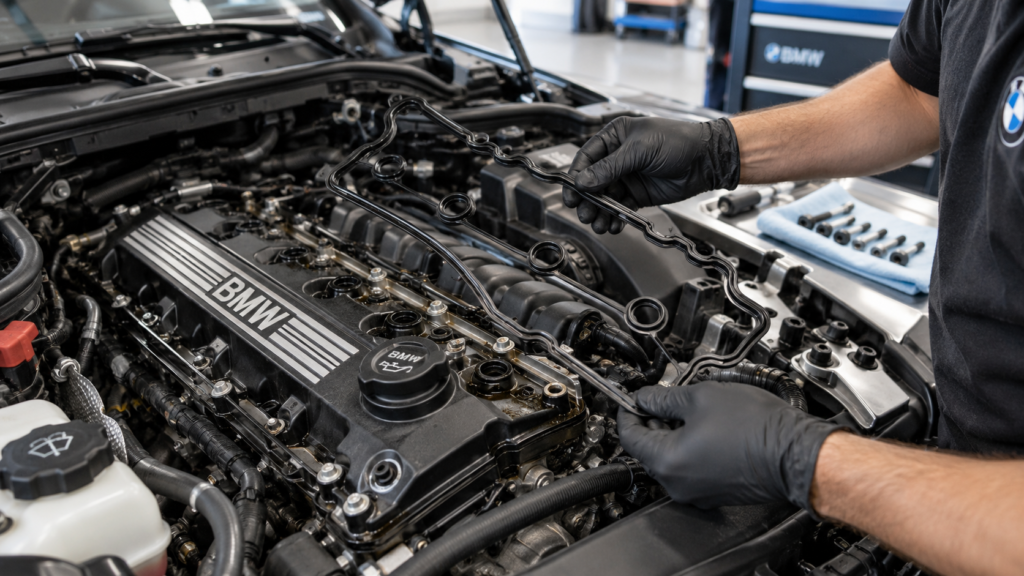
This guide breaks down typical BMW valve cover gasket costs, dealer vs independent-shop vs DIY pricing, model differences, symptoms, labor, and when replacing the complete valve cover makes more sense than installing another gasket.
| Repair | Typical Planning Range |
|---|---|
| DIY gasket only | $50–$200+ |
| Independent shop, gasket replacement | $600–$1,200+ |
| Dealer, gasket replacement | $800–$1,500+ |
| Professional complete valve cover replacement | $900–$1,800+ |
How Much Does BMW Valve Cover Gasket Replacement Cost?
For many BMWs, a realistic professional repair budget is roughly $600 to $1,300 when the job is limited primarily to the valve cover gasket and related seals.
Older or easier-to-access BMW engines may fall below that range. Newer engines, SUVs, higher local labor rates, and repairs requiring additional parts can push the total higher.
The gasket itself usually is not what makes this an expensive repair. Labor can account for most of the bill because the technician may need to remove ignition coils, wiring, brackets, hoses, covers, and other components before the valve cover can come off.
If the complete valve cover also needs replacement, parts cost can rise substantially.
BMW Valve Cover Gasket Cost by Model
BMW uses different engines and valve cover designs across models and generations, so model-specific pricing varies. The following ranges are useful for budgeting, but the engine installed in the car matters as much as the badge on the trunk.
| BMW Model | Typical Professional Gasket-Only Range | What Can Raise the Cost |
|---|---|---|
| BMW 328i | About $650–$950 | Complete cover, PCV issues, damaged hardware |
| BMW 335i | About $750–$1,150 | Turbo-engine packaging and complete-cover replacement |
| BMW 330i | About $700–$1,200+ | Generation, B48 application, cover condition |
| BMW X3 | About $800–$1,250+ | Engine generation and newer-model labor costs |
| BMW X5 | About $850–$1,300+ | Engine choice and tighter packaging |
Always identify the exact engine before ordering parts. A 328i, 330i, X3, or X5 from one generation may use a completely different valve cover and gasket from another vehicle carrying the same model name.
BMW Valve Cover Gasket Replacement: Dealer vs Independent Shop vs DIY
BMW Dealer
A BMW dealer will usually be the most expensive option because of higher labor rates and the tendency to use genuine BMW parts and complete factory repair procedures.
A dealer repair can make sense if the car is under warranty, you prefer factory parts and documentation, or diagnosis shows that the leak involves more than a simple gasket.
For an out-of-warranty BMW, however, an experienced independent BMW specialist can often perform the same basic repair for less.
Independent BMW Shop
For most owners who are not doing the repair themselves, a reputable independent BMW or European specialist is usually the best balance of cost and expertise.
An experienced BMW technician will also know to inspect the valve cover itself, crankcase ventilation system, ignition-coil wells, related seals, and surrounding oil-leak areas before simply installing a gasket and sending the car out.
DIY
DIY can save hundreds of dollars because most of the professional repair bill is labor.
The job is not necessarily technically complicated, but access can be time-consuming and careful preparation matters. The valve-cover sealing surfaces need to be clean, bolts must be handled correctly, hoses and connectors can become brittle with age, and the cover should be inspected rather than automatically reused.
Valve Cover Gasket vs Complete BMW Valve Cover Replacement
This is one of the most important decisions in the repair.
If the valve cover is structurally sound and the only problem is an aged rubber gasket, replacing the gasket can be the least expensive solution.
However, BMW has used plastic valve covers on many engines. Heat cycles and age can eventually contribute to warping, cracking, damaged sealing surfaces, or problems with integrated crankcase-ventilation components.
Installing a fresh gasket on a damaged cover may not permanently fix the leak.
| Gasket Only May Make Sense When… | Complete Cover May Make More Sense When… |
|---|---|
| Cover is flat and undamaged | Cover is warped or cracked |
| PCV system is functioning normally | Integrated PCV system has failed |
| Leak is clearly from an aged gasket | Cover itself is leaking or damaged |
| Vehicle has relatively low mileage | Old plastic cover has extensive heat cycles |
| Replacement gasket properly seals the cover | Previous gasket replacement did not stop the leak |
The labor to remove and reinstall the valve cover is already a major part of the repair. If the cover is questionable, replacing it during the same job can make more financial sense than paying much of the labor again later.
Symptoms of a BMW Valve Cover Gasket Leak
A valve cover gasket can start leaking slowly, so the first sign is not always oil dripping onto the ground.
Common symptoms include:
- Burning oil smell after driving
- Smoke from the engine bay
- Visible oil around the valve-cover perimeter
- Oil collecting around the ignition coils or spark plugs
- Oil residue running down the side of the engine
- Gradually dropping engine-oil level
- Misfires if oil contaminates ignition components
If you are not certain where the oil is coming from, start with our BMW oil leak guide. Oil filter housing leaks, oil pan leaks, and other engine leaks can sometimes travel across the engine and make the source less obvious than it appears.
Why Do BMW Valve Cover Gaskets Leak?
The gasket lives in a hot environment and experiences thousands of engine heat cycles. Over time, rubber sealing material can harden, shrink, flatten, or crack.
Age and mileage are not the only causes. The repair can also be affected by:
- A warped or cracked valve cover
- Excessive crankcase pressure
- Problems with the PCV or crankcase-ventilation system
- Incorrect previous installation
- Damaged sealing surfaces
- Improper bolt torque or tightening sequence
This is why diagnosing the leak before ordering a gasket is worthwhile. The cheapest part is not necessarily the cheapest repair if the underlying problem remains.
BMW Valve Cover Leaks by Engine Family
The basic purpose of the valve cover gasket is the same across BMW engines, but the repair details vary considerably by engine family.
N52
The naturally aspirated N52 appears in many 3 Series, 5 Series, X3, X5, and other BMW applications. On an older N52, inspect the condition of the complete cover and surrounding components in addition to the gasket, especially if the car has accumulated substantial mileage and heat cycles.
N20 / N26
The turbocharged four-cylinder N20 and N26 engines appear in models such as the 328i, 528i, X1, and X3. Verify whether the leak is actually coming from the valve-cover area because these engines can also develop oil leaks elsewhere.
N54 / N55
Turbocharged six-cylinder BMWs using the N54 or N55 deserve a careful inspection around the valve cover, ignition-coil wells, and nearby oil-leak locations. Oil contamination around the plugs or coils can contribute to ignition problems even though the gasket leak is the original cause.
B48 / B58
Later B48 four-cylinder and B58 six-cylinder engines use different components and layouts from earlier BMW engines, so do not buy parts based only on a model name such as 330i, X3, or 340i. Confirm the exact engine and production application first.
Can a Valve Cover Gasket Leak Cause a BMW Misfire?
It can contribute to one.
On some BMW engines, leaking oil can collect in the spark-plug wells. Oil around the spark plug or ignition coil can interfere with ignition components and contribute to misfire symptoms.
If you find oil while replacing plugs or coils, fixing only the ignition component may leave the actual oil leak unresolved.
For related repair costs, see our BMW spark plug replacement cost guide and BMW ignition coil replacement cost guide.
Can You Drive With a Leaking BMW Valve Cover Gasket?
A minor seep is different from a leak that is actively dripping oil onto hot engine or exhaust components.
A small leak may not require the car to be parked immediately, but it should not simply be ignored. Valve cover leaks tend to worsen rather than repair themselves.
Move the repair higher on the priority list if:
- You smell burning oil
- You see smoke from the engine bay
- Oil is reaching the exhaust area
- Oil is filling the spark-plug wells
- The engine oil level is dropping noticeably
- The BMW is misfiring
Continue monitoring the oil level until the repair is completed. If oil loss becomes significant or smoke is heavy, stop treating it as a minor seep and have the vehicle inspected.
What Else Should Be Replaced During the Job?
Because labor access is a major part of the repair, it makes sense to inspect related components while the valve cover is removed.
Depending on the BMW and the parts kit, consider inspecting or replacing:
- Valve cover gasket
- Spark-plug tube seals where applicable
- Valve-cover bolt seals or grommets where applicable
- Cracked or damaged breather hoses
- Complete valve cover if warped, cracked, or otherwise damaged
- Related PCV components where applicable
- Spark plugs if oil contamination or service interval justifies replacement
A complete repair kit can be convenient because it groups many of the seals and hardware needed for the job rather than requiring each small component to be ordered separately.
Is BMW Valve Cover Gasket Replacement a Good DIY Job?
For an experienced DIY owner, it can be. The parts cost is far lower than the professional repair price, which makes the potential savings substantial.
However, this is not a job where rushing pays off. Depending on the BMW, access may be tight and plastic connectors or hoses can become brittle as the vehicle ages.
You should be comfortable with:
- Removing ignition coils and surrounding engine components
- Disconnecting electrical connectors and hoses without damaging them
- Cleaning gasket mating surfaces carefully
- Following the correct tightening sequence
- Using the proper torque specifications for your exact engine
- Recognizing when the complete valve cover should not be reused
Do not guess at torque values or sealant locations. Use repair information specific to your BMW engine.
How Long Does BMW Valve Cover Gasket Replacement Take?
Labor time varies significantly by engine and chassis. A professional familiar with the platform may complete some BMW valve cover gasket jobs in several hours, while tighter or more complex applications require substantially more time.
A first-time DIY repair usually takes longer because the job involves identifying connectors, carefully moving wiring and hoses, cleaning surfaces, and checking the old cover for damage.
Labor is therefore one of the biggest reasons the installed repair price is much higher than the gasket itself.
How to Avoid Paying for the Repair Twice
Before approving or performing the repair, determine whether the leak is truly caused only by the gasket.
If the cover is cracked or warped, the crankcase-ventilation system has a problem, or another oil leak is being mistaken for the valve cover gasket, installing a new gasket alone may not solve the problem.
The best repair is not automatically the cheapest parts option. On an older BMW, spending more on a complete valve cover or a comprehensive kit can be less expensive than repeating the labor six months later.
Is BMW Valve Cover Gasket Replacement Worth Fixing?
Yes. A leaking valve cover gasket is generally a repair worth addressing rather than treating as permanent BMW ownership background noise.
The repair prevents oil from continuing to spread around the engine, reduces the chance of oil contaminating ignition components, and helps keep oil away from hot surfaces.
The important decision is not whether to fix the leak, but whether your BMW needs only a gasket or whether the complete valve cover should be replaced at the same time.
For a lower-mileage car with a healthy cover, a gasket-only repair can make sense. For an older plastic cover that is warped, cracked, or experiencing integrated PCV problems, paying for the complete cover while everything is already apart may be the better long-term repair.
BMW Valve Cover Gasket Replacement Cost FAQ
How much does it cost to replace a BMW valve cover gasket?
A professional BMW valve cover gasket replacement commonly costs roughly $600 to $1,300, although older applications can cost less and newer or more labor-intensive models can cost more. Complete valve cover replacement can push the total higher.
Why is a BMW valve cover gasket so expensive to replace?
The gasket itself is relatively inexpensive. Labor is the major expense because surrounding components must be removed to access the valve cover, and some BMW applications require several hours of work.
Should I replace the valve cover or only the gasket?
If the cover is flat, undamaged, and its related systems are functioning normally, replacing only the gasket may be reasonable. A warped or cracked cover, integrated PCV problem, or repeat leak can justify replacing the complete cover.
Can a BMW valve cover gasket leak cause a burning smell?
Yes. Oil leaking from the upper engine can reach hot surfaces and create a noticeable burning-oil smell or even visible smoke from the engine bay.
Can a BMW valve cover gasket leak cause a misfire?
It can contribute to misfires if leaking oil reaches the spark-plug wells or ignition components. The ignition problem should be repaired along with the source of the oil contamination.
Can I replace a BMW valve cover gasket myself?
Experienced DIY owners can replace many BMW valve cover gaskets and save substantially on labor. Use engine-specific repair instructions and torque specifications, and inspect the complete valve cover rather than assuming it can always be reused.