BMW P0300–P0306 Misfire Codes: Meaning, Causes & Diagnosis
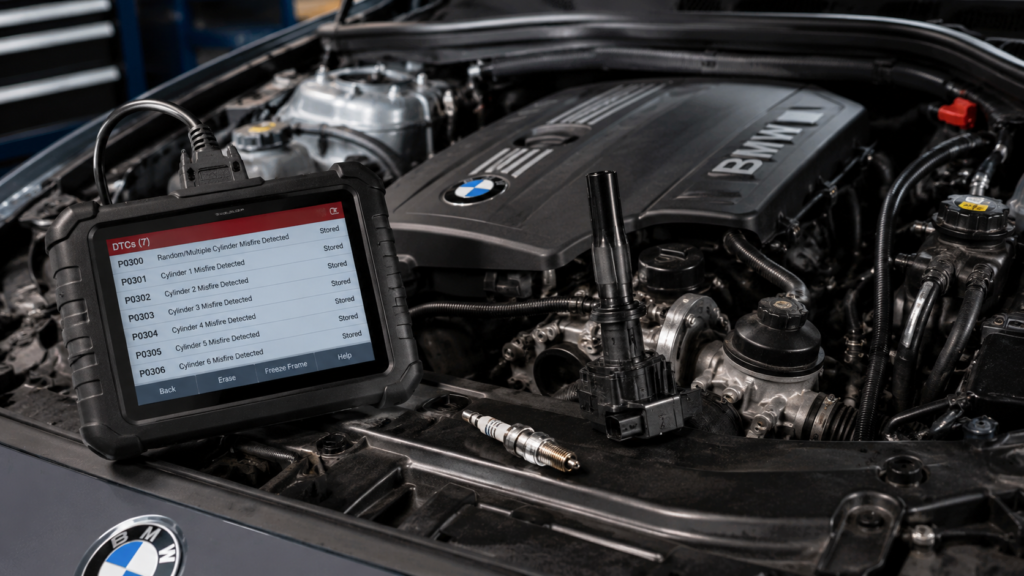
A BMW P0300, P0301, P0302, P0303, P0304, P0305, or P0306 code means the engine computer has detected one or more cylinder misfires. The difference between the codes is which cylinder—or combination of cylinders—is affected.
P0300 indicates a random or multiple-cylinder misfire. P0301 through P0306 point to a specific numbered cylinder. On a BMW, these codes can be caused by something relatively simple such as a worn spark plug or failed ignition coil, but injectors, air leaks, fuel-delivery problems, wiring faults, or mechanical issues can produce similar symptoms.
This guide explains what each BMW P0300–P0306 code means, the most common causes, how to diagnose the problem without replacing parts at random, and when a misfire is serious enough that you should stop driving.
This page contains affiliate links. If you buy through them, we may earn a commission at no extra cost to you.
BMW P0300–P0306 Codes: Quick Answer
| Code | Meaning | Where to Start |
|---|---|---|
| P0300 | Random or multiple-cylinder misfire detected | Look for patterns affecting more than one cylinder |
| P0301 | Cylinder 1 misfire detected | Inspect plug, coil, injector and cylinder-specific issues |
| P0302 | Cylinder 2 misfire detected | Inspect plug, coil, injector and cylinder-specific issues |
| P0303 | Cylinder 3 misfire detected | Inspect plug, coil, injector and cylinder-specific issues |
| P0304 | Cylinder 4 misfire detected | Inspect plug, coil, injector and cylinder-specific issues |
| P0305 | Cylinder 5 misfire detected | Inspect plug, coil, injector and cylinder-specific issues |
| P0306 | Cylinder 6 misfire detected | Inspect plug, coil, injector and cylinder-specific issues |
A single-cylinder code such as P0302 usually gives you a narrower starting point than P0300. If several cylinder-specific codes appear together, think about problems that can affect multiple cylinders before replacing several coils or injectors at once.
What Does BMW P0300 Mean?
BMW P0300 means the engine computer has detected a random or multiple-cylinder misfire rather than consistently identifying only one cylinder.
P0300 deserves a slightly different diagnostic approach from a single-cylinder code. If several cylinders are misfiring, replacing one ignition coil may not solve the underlying problem.
Common directions to investigate with a BMW P0300 code include:
- Multiple worn or fouled spark plugs
- More than one weak ignition coil
- Vacuum or unmetered-air leaks
- Fuel-pressure or fuel-delivery problems
- Injector problems affecting more than one cylinder
- Electrical or wiring faults
- Mechanical or compression problems
- Additional BMW-specific faults that point toward the real cause
This is why you should scan the BMW for all stored and pending codes, not stop after seeing P0300.
For example, P0300 accompanied by a lean-condition code points the diagnosis in a different direction from P0300 accompanied by several cylinder-specific misfire codes.
BMW P0301: Cylinder 1 Misfire
BMW P0301 means a misfire has been detected on cylinder 1.
When only one cylinder is affected, start with components unique to that cylinder. The usual first checks are the spark plug and ignition coil because they are relatively accessible and can often be compared with a known-good cylinder.
If the coil and plug check out, move deeper into injector operation, wiring, fuel delivery to that cylinder, and mechanical condition.
BMW P0302: Cylinder 2 Misfire
BMW P0302 indicates a misfire on cylinder 2.
The diagnostic process is similar to P0301: inspect the spark plug, evaluate or swap the ignition coil when appropriate, check the electrical connector and wiring, and then investigate the injector or mechanical condition if the misfire remains on cylinder 2.
BMW P0303: Cylinder 3 Misfire
BMW P0303 means the engine computer detected a cylinder 3 misfire.
Do not assume the ignition coil has failed just because the code names one cylinder. A worn plug, damaged coil boot, injector issue, wiring fault, oil contamination around the ignition components, or low compression can all keep the misfire isolated to one cylinder.
BMW P0304: Cylinder 4 Misfire
BMW P0304 indicates a misfire on cylinder 4.
Because P0304 is cylinder-specific, a coil-swap test can be especially useful when the BMW uses individual coil-on-plug ignition. If the misfire follows the coil to another cylinder, you have strong evidence that the coil itself is faulty.
If the code remains P0304 after moving a known-good coil into that position, continue diagnosing rather than buying another coil.
BMW P0305: Cylinder 5 Misfire
BMW P0305 means cylinder 5 is misfiring.
As with the other cylinder-specific codes, start with the easiest things to verify. Check the plug and coil, inspect for connector or wiring damage, and pay attention to whether the misfire changes when components are moved between cylinders.
If ignition parts do not change the fault, injector testing and mechanical diagnosis become more important.
BMW P0306: Cylinder 6 Misfire
BMW P0306 indicates a misfire on cylinder 6.
The code should be approached the same way as P0301–P0305: prove whether the fault follows a replaceable ignition component before moving into more expensive fuel-system or mechanical diagnosis.
On engines with six cylinders, do not assume the physical cylinder location from the code alone unless you have confirmed the cylinder numbering for your exact BMW engine.
Most Common Causes of BMW P0300–P0306 Codes
1. Worn or Fouled Spark Plugs
Spark plugs are one of the first things to inspect when a BMW develops a misfire, especially if the plugs are already due for replacement or the engine has been running under higher boost or load.
Look for:
- Excessive electrode wear
- Incorrect gap
- Carbon fouling
- Oil contamination
- Cracked porcelain
- Incorrect plug specification
- Installation problems after recent spark-plug service
If the plugs are due and you have confirmed the correct fitment for your BMW, you can compare replacement options here:
2. Failed or Weak Ignition Coil
Individual ignition coils are another common starting point for a single-cylinder misfire.
The key is to prove the coil is causing the problem when possible rather than replacing all of them because one cylinder stored a misfire code.
If a coil from the misfiring cylinder is moved to another cylinder and the misfire code follows it, that strongly supports a failed coil diagnosis.
3. Fuel Injector Problem
If the plug and ignition coil are functioning correctly but the same cylinder continues to misfire, the injector becomes one possible next direction.
Injector problems can include poor electrical operation, restricted fuel delivery, leakage, or another fault that prevents the cylinder from receiving the correct amount of fuel.
Injector diagnosis can become more involved than a basic coil-swap test, so do not buy an injector solely because the misfire stayed on the same cylinder after moving the coil.
4. Vacuum, Intake, or Unmetered-Air Leak
Air leaks become especially important when P0300 or several cylinder misfire codes appear together.
An intake leak, vacuum leak, damaged hose, PCV-related issue, or another source of unmetered air can disturb the air-fuel mixture enough to cause rough idle and multiple-cylinder misfires.
Associated lean-condition codes can provide another clue that the problem is broader than one bad ignition coil.
5. Fuel-Pressure or Fuel-Delivery Problem
If several cylinders misfire under load, acceleration, or particular operating conditions, fuel delivery deserves attention.
The exact BMW fuel system varies by engine, but insufficient fuel supply, pressure-control problems, or other delivery faults can affect more than one cylinder at the same time.
6. Wiring or Electrical Fault
A perfectly good coil or injector cannot work correctly if its connector, wiring, power supply, or control circuit is damaged.
Pay particular attention to electrical problems when:
- The misfire began immediately after other engine work
- A connector does not lock correctly
- Wiring has been pulled, pinched, or damaged
- Moving the coil does not move the misfire
- The fault is intermittent
7. Compression or Mechanical Problem
If spark, ignition, fuel, and electrical checks do not explain a persistent cylinder-specific misfire, mechanical condition needs to be considered.
Low compression, valve problems, sealing issues, or other internal engine faults can prevent a cylinder from contributing normally even when the ignition and injector systems are working.
This is the point where compression, leak-down, or other mechanical testing may be more useful than buying another set of ignition parts.
Single-Cylinder vs Multiple-Cylinder BMW Misfires
One of the most useful clues is whether the BMW has one cylinder-specific misfire or several cylinders misfiring together.
| Code Pattern | What It Suggests | Good Starting Point |
|---|---|---|
| P0301 only | Problem isolated to cylinder 1 | Plug, coil, injector, wiring, compression |
| P0304 only | Problem isolated to cylinder 4 | Plug, coil, injector, wiring, compression |
| P0300 + several P030X codes | Multiple cylinders affected | Look for a shared cause as well as individual faults |
| Several cylinders + lean code | Possible mixture or unmetered-air issue | Inspect intake/vacuum system and fuel data |
| Several cylinders under acceleration | Ignition or fuel-delivery problem may show under load | Review plugs, coils, fuel delivery and live data |
This pattern-based diagnosis can save significant money. Replacing six ignition coils because the engine has six misfire codes is very different from proving that six coils failed at the same time.
How to Diagnose BMW P0300–P0306 Codes
The goal is to find evidence before replacing parts. Use the simplest tests first and move toward more involved diagnosis only when necessary.
Step 1: Scan the BMW and Record Every Code
Do not clear the codes immediately. Record the P0300–P0306 code and any other stored, pending, BMW-specific, fuel-mixture, sensor, or power-management faults.
A generic code reader may show the basic P030X code, while a BMW-capable diagnostic tool can provide a much broader picture of what the vehicle is reporting.
Step 2: Determine Whether the Misfire Is One Cylinder or Several
If you have P0303 and nothing else, concentrate initially on cylinder 3. If you have P0300 plus P0301, P0302, P0303, and P0304, look for a problem capable of affecting several cylinders.
Step 3: Inspect the Spark Plug
Remove and inspect the plug from the affected cylinder when appropriate.
Compare its condition with the plugs from cylinders that are not misfiring. A visibly damaged, heavily worn, contaminated, or incorrectly installed plug can provide an immediate clue.
Step 4: Perform a Coil-Swap Test
On a BMW with individual coil-on-plug ignition, moving the suspected coil to another cylinder can be one of the most useful low-cost tests.
Example:
- The BMW has P0302.
- Move the cylinder 2 coil to a known-good cylinder.
- Move that known-good coil to cylinder 2.
- Run or drive the vehicle as appropriate and rescan it.
- If the misfire moves with the coil, the coil becomes the likely cause.
- If the code remains P0302, continue diagnosing cylinder 2 instead of buying another coil.
For a more complete walkthrough, see our BMW misfire diagnosis guide.
Step 5: Check Wiring and Connectors
Before assuming an expensive injector or engine problem, make sure the electrical connection to the coil and injector is intact and that no wiring was damaged during recent service.
Step 6: Investigate Injector and Fuel Delivery
If the ignition components test correctly and the misfire remains on the same cylinder, continue into injector and fuel-system diagnosis.
If multiple cylinders are affected, use the complete fault picture and live data to determine whether the issue may involve shared fuel delivery rather than several individual injectors.
Step 7: Check for Intake or Vacuum Leaks
This becomes especially important with P0300, multiple-cylinder faults, rough idle, or accompanying lean codes.
Step 8: Move to Mechanical Testing When Necessary
If the plug, coil, injector, wiring, air-fuel mixture, and related systems do not explain a persistent misfire, investigate compression and mechanical condition.
Continuing to throw ignition parts at a cylinder with a mechanical problem only increases the repair bill.
BMW Misfire After Changing Spark Plugs or Ignition Coils
If P0300–P0306 appeared immediately after spark-plug or ignition-coil work, inspect the work before assuming a completely unrelated component failed at the same time.
Check for:
- Coil connector not fully seated
- Coil not fully installed onto the plug
- Wrong spark plug
- Damaged spark-plug porcelain
- Incorrect plug gap where applicable
- Plug installation or torque problem
- Coil boot damage
- Wiring disturbed during the repair
A new part can also be defective, but verify the installation before replacing more components.
Can You Drive With BMW P0300–P0306?
A mild intermittent misfire is different from an engine that is shaking violently or flashing the check engine light.
Continuing to drive a BMW with a severe active misfire can create additional problems, including unburned fuel reaching the catalytic converter.
Treat the problem as higher priority if:
- The check engine light is flashing
- The engine is shaking heavily
- Power is severely reduced
- The car enters a protective or reduced-power mode
- You smell raw fuel
- Several cylinders are misfiring
- The misfire becomes dramatically worse under load
If the engine is running very poorly or the check engine light is flashing, avoid unnecessary driving until the cause is identified.
Should You Replace All BMW Ignition Coils at Once?
Not automatically.
If testing shows that one coil has failed, replacing only that coil can be reasonable. Some owners choose to replace a complete aging set when several coils are original, high-mileage, or beginning to fail close together, but that is a maintenance decision—not something the P030X code itself requires.
The most useful question is whether the misfire follows the suspected coil. If it does, you have evidence. If it does not, keep diagnosing.
BMW P0300–P0306 FAQ
What does BMW P0300 mean?
BMW P0300 means the engine computer detected a random or multiple-cylinder misfire. Because more than one cylinder may be involved, check for shared causes such as air-fuel problems in addition to individual plugs or coils.
What does BMW P0301 mean?
BMW P0301 means a misfire has been detected on cylinder 1. Start by checking cylinder-specific ignition components such as the spark plug and coil before moving into injector, wiring, or mechanical diagnosis.
What does BMW P0302 mean?
BMW P0302 means the vehicle detected a misfire on cylinder 2. Inspect the spark plug, ignition coil, wiring and connector, then investigate the injector and mechanical condition if the problem remains on the same cylinder.
What does BMW P0303 mean?
BMW P0303 indicates a cylinder 3 misfire. A coil-swap test can help determine whether the ignition coil is responsible before you replace additional parts.
What does BMW P0304 mean?
BMW P0304 means a misfire has been detected on cylinder 4. The cause may be a plug, coil, injector, wiring fault, air-fuel issue, or mechanical problem affecting that cylinder.
What does BMW P0305 mean?
BMW P0305 indicates a cylinder 5 misfire. Diagnose the ignition components first when appropriate, then move into injector and mechanical testing if the fault stays on cylinder 5.
What does BMW P0306 mean?
BMW P0306 means a misfire was detected on cylinder 6. Check the plug, ignition coil, wiring and injector before assuming the engine has an internal mechanical problem.
Can bad spark plugs cause P0300?
Yes. Multiple worn, fouled, incorrectly gapped, or otherwise faulty spark plugs can contribute to multiple-cylinder misfires. However, P0300 can have many other causes, so inspect the complete fault pattern before replacing plugs.
Can a bad ignition coil cause P0301–P0306?
Yes. A failed coil can cause a cylinder-specific misfire code. When practical, swap the suspected coil with a known-good cylinder and see whether the misfire follows the coil.
Will clearing a BMW misfire code fix the problem?
No. Clearing the code only removes the stored fault information. If the underlying misfire remains, the code will usually return. Diagnose and repair the cause rather than treating code clearing as a repair.
Do I need a BMW-specific scanner for P0300–P0306?
A generic OBD2 reader can often display standardized P0300–P0306 codes, but a BMW-capable diagnostic tool can provide additional module faults, live data, and BMW-specific information that may make diagnosis easier.
Final Recommendation
If your BMW has a P0300–P0306 misfire code, resist the urge to start replacing ignition parts based only on the cylinder number.
Start by recording every fault code and determining whether the problem affects one cylinder or several. For a single-cylinder misfire, inspect the spark plug and use a coil-swap test when appropriate. If the misfire stays on the same cylinder, continue into injector, wiring, and mechanical diagnosis.
If P0300 or several cylinder codes appear together, pay more attention to problems that can affect multiple cylinders, including air leaks, fuel delivery, multiple worn ignition components, or another shared engine-management issue.
The goal is simple: prove which component is causing the misfire before buying it.