BMW N20 Oil Leak: Common Leak Locations, Symptoms & What to Fix First
This post may contain affiliate links. If you buy through one of our links, we may earn a commission at no extra cost to you.
A BMW N20 oil leak can come from several different places, and the location matters because the repair can range from a relatively straightforward gasket replacement to a much more labor-intensive lower-engine job.
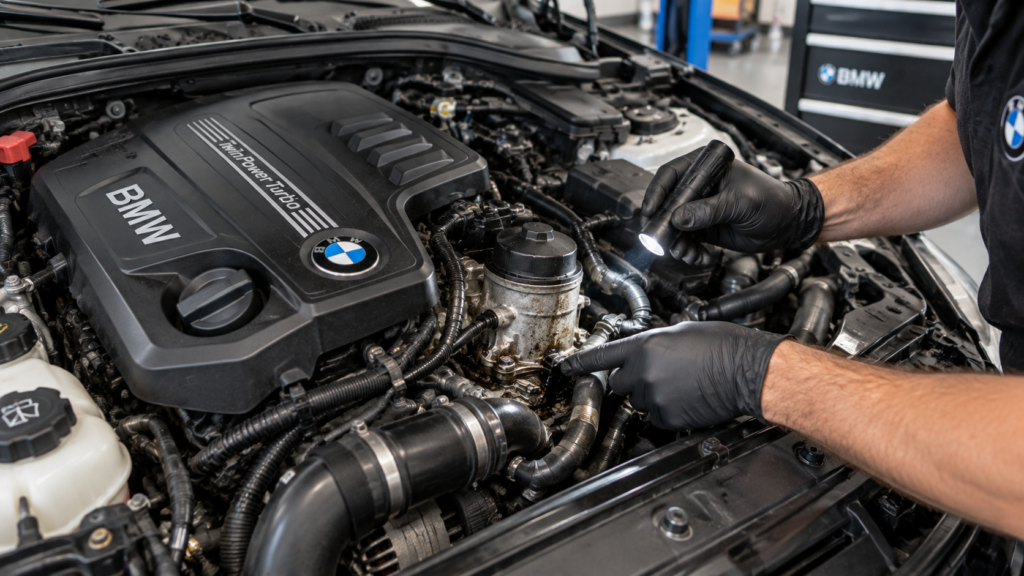
The most important areas to inspect on an N20 include the valve cover and valve cover gasket, oil filter housing, vacuum pump area, and oil pan. Oil can also travel across the engine or down the block, so the wettest area is not always the true source.
This guide explains the common N20 oil leak locations, what symptoms point toward each one, how urgent the repair may be, and what to fix first rather than replacing parts based only on where oil finally drips onto the ground.
| Leak Area | Typical Clue | Priority |
|---|---|---|
| Valve cover / gasket | Oil high on engine, burning smell, oil near coils | Medium to high |
| Oil filter housing | Oil near front/side of engine around filter housing | High |
| Vacuum pump seal | Oil near rear of valve cover / vacuum pump area | Medium to high |
| Oil pan | Oil concentrated along bottom of engine | Usually medium |
| Turbo oil-feed / turbo sealing issue | Blue smoke after startup rather than an obvious external leak | Needs diagnosis |
Common BMW N20 Oil Leak Locations
The N20 is a turbocharged four-cylinder engine used across several BMW models. Like many BMW engines, it has multiple sealing surfaces that can begin leaking after years of heat cycles.
Do not assume every N20 oil leak needs the same repair. Start at the highest visible oil residue and work downward before condemning a lower gasket.
1. N20 Valve Cover and Valve Cover Gasket Leak
The valve cover is one of the first places to inspect when oil is visible near the top of the N20 engine.
The N20 uses a plastic valve cover with sealing gaskets. Over time, the gasket can harden and lose its ability to seal properly. The cover itself also needs to be inspected rather than assuming that replacing the gasket alone will always solve the problem.
Possible signs include:
- Oil residue around the valve-cover perimeter
- Burning-oil smell after driving
- Smoke from oil reaching hot engine or exhaust components
- Oil around ignition coils or spark-plug wells
- Oil running down the side of the engine
BMW has documented N20/N26 oil leakage from the cylinder-head-cover area, so this should be treated as a real diagnostic starting point rather than assuming oil higher on the engine came from somewhere below it.
If the leak is confirmed at the valve cover, our BMW valve cover gasket replacement cost guide explains gasket-only vs complete-cover replacement, professional labor costs, and DIY considerations.
2. N20 Oil Filter Housing Leak
The oil filter housing is another important N20 leak location.
The housing seals against the engine with a gasket that is exposed to repeated heating and cooling. As the gasket ages, oil can begin seeping from the housing area and spread across the front or side of the engine.
Look closely around the housing instead of assuming oil in that area came from a valve-cover leak above it.
Common clues include:
- Fresh oil around the oil filter housing
- Oil residue down the front or side of the engine
- A gradually worsening leak rather than one sudden puddle
- Oil appearing shortly after the engine has been running
This leak deserves attention rather than being treated as harmless BMW seepage. Repair generally requires removing surrounding components, and both oil and coolant may need to be drained depending on the work being performed.
Some early N20-equipped BMWs also had a BMW service action involving certain plastic oil filter housings that could develop internal or external oil or coolant leaks. Vehicle-specific service history and VIN applicability should be checked rather than assuming every N20 uses the same housing.
3. N20 Vacuum Pump Oil Leak
The vacuum pump sits at the rear of the N20 valve-cover area and is another location worth inspecting when the back of the engine appears oily.
A leaking vacuum-pump seal can be easy to confuse with a valve-cover leak because the components are close together and gravity carries oil downward.
Depending on the exact problem, you may see oil around the pump area or even find oil where it should not be within associated vacuum components.
Because the vacuum system supports important vehicle functions, this is not a leak location to diagnose casually. Confirm whether the oil is coming from the pump seal, the nearby valve cover, or another source before ordering parts.
4. N20 Oil Pan Gasket Leak
If the upper engine is relatively dry but oil is concentrated around the bottom of the engine, the oil pan or its sealing surface becomes a more likely suspect.
The challenge is that oil leaking from the valve cover or oil filter housing can run down the engine and eventually make the oil-pan area look wet. That can lead to an expensive misdiagnosis.
Before assuming the pan is leaking:
- Clean accumulated oil from the engine
- Inspect the upper leak points first
- Recheck after driving
- Look for fresh oil beginning specifically at the oil-pan sealing area
Oil-pan repair is also more labor intensive than the inexpensive gasket might suggest. Access varies between rear-wheel-drive and xDrive applications, so the final cost is driven much more by labor than by the seal itself.
5. Blue Smoke May Not Be an External N20 Oil Leak
Not every N20 oil-loss complaint creates oil on the outside of the engine.
If the BMW produces a brief plume of blue smoke after a cold start but the engine bay and underside do not show an obvious external leak, the diagnosis needs to move beyond gaskets.
BMW documented certain N20 applications where oil could pass into the turbocharger exhaust side after the vehicle sat overnight. The updated repair involved a revised turbocharger oil-feed line with a check valve.
That symptom is different from an external valve-cover, filter-housing, or oil-pan leak. Do not start replacing external gaskets simply because the engine is consuming oil or producing blue smoke.
How to Tell Where Your N20 Oil Leak Is Coming From
Oil spreads easily, especially once airflow moves it around the engine bay while driving. Diagnosis should therefore begin with the highest fresh oil rather than the lowest wet component.
| Where You See Oil | Check First |
|---|---|
| Top or perimeter of valve cover | Valve cover gasket and cover condition |
| Around ignition coils / plug wells | Valve cover sealing area |
| Front/side near oil filter | Oil filter housing and gasket |
| Rear of upper engine | Vacuum pump and valve-cover area |
| Only at bottom of engine | Verify upper engine is dry, then inspect oil pan |
| No external oil but blue startup smoke | Turbo oil-feed / internal oil-consumption diagnosis |
If the engine is covered in old oil, cleaning the area first may be necessary. A fresh leak trail is much more useful than months of accumulated residue.
For a broader diagnostic process covering other BMW engines as well, see our BMW oil leak guide.
BMW N20 Oil Leak Symptoms
An N20 oil leak does not always start with oil on the driveway. Watch for several possible clues:
- Burning-oil smell
- Smoke from the engine bay
- Visible oil residue on the engine
- Oil around the ignition coils or spark plugs
- Oil collecting on splash shields or undertrays
- Drips under the vehicle
- Gradually declining engine-oil level
- Blue exhaust smoke in cases involving internal oil entry
Do not rely only on the dashboard oil-level warning. A smaller leak may be active for some time before the oil level drops far enough to trigger a warning.
Which BMW Models Use the N20 Engine?
The N20 appeared in a wide range of turbocharged four-cylinder BMWs. Exact engine fitment varies by year and market, so confirm the engine before ordering parts.
| Common N20 Application | Examples |
|---|---|
| 2 Series | 228i |
| 3 Series | 320i, 328i |
| 4 Series | 428i |
| 5 Series | 528i |
| X1 | sDrive28i / xDrive28i |
| X3 | sDrive28i / xDrive28i |
| X4 | xDrive28i |
| Z4 | sDrive28i |
The closely related N26 shares many service procedures and leak locations with the N20, but always confirm the exact engine and emissions configuration before buying parts.
Which N20 Oil Leak Should You Fix First?
Repair priority should be based on leak severity and where the oil is going, not simply which gasket is cheapest.
| Situation | Priority |
|---|---|
| Oil reaching hot exhaust components | High |
| Oil filter housing actively leaking | High |
| Oil contaminating spark-plug wells | High |
| Noticeable oil-level loss | High |
| Small valve-cover seep with stable oil level | Monitor but schedule repair |
| Light oil-pan seep with no measurable loss | Usually lower priority, confirm source first |
| Blue smoke without external leak | Diagnose separately before replacing gaskets |
A leak should move up the repair list if oil is reaching the exhaust, affecting ignition components, spreading rapidly, or causing a measurable drop in engine-oil level.
N20 Valve Cover Gasket vs Complete Valve Cover
If the leak is at the valve-cover area, determine whether the gasket alone is actually the problem.
A gasket-only repair may be appropriate when the cover is undamaged and the sealing surfaces are in good condition. If the plastic cover is cracked, warped, or otherwise compromised, paying the labor to reinstall it with only a fresh gasket may lead to another repair later.
The complete cover should therefore be inspected while everything is apart.
Can an N20 Oil Leak Cause a Misfire?
It can contribute to one if oil reaches the spark-plug wells or ignition coils.
In that situation, replacing only the spark plug or ignition coil without repairing the leak leaves the underlying problem in place.
For related repair information, see our BMW spark plug replacement cost guide and BMW ignition coil replacement cost guide.
Can You Keep Driving With an N20 Oil Leak?
A minor seep is different from an active leak that is dripping onto hot components or lowering the engine-oil level.
If the leak is small, the oil level remains stable, and there is no smoke or burning smell, you may have time to schedule the repair rather than immediately parking the car.
Do not delay diagnosis if:
- You smell burning oil
- Smoke is coming from the engine bay
- Oil is dripping rapidly
- The oil level is falling noticeably
- Oil is contaminating ignition components
- A warning appears for low engine oil
Continue monitoring the oil level until the source is repaired. A small oil leak can become a larger one as a gasket or plastic component continues aging.
DIY vs Shop Diagnosis
Finding the source of an N20 oil leak is often a reasonable DIY diagnostic task even if you ultimately pay a shop to perform the repair.
Start by removing enough covers to see the engine clearly, use a good light, and inspect from the top down. Clean old oil if necessary and then watch for fresh residue after driving.
A repair shop becomes more useful when the source is unclear, several areas are wet, the oil pan appears involved, or the symptom is oil consumption or blue smoke rather than an obvious external leak.
Do not authorize an expensive oil-pan repair merely because the bottom of the engine is oily until the upper engine has been inspected.
BMW N20 Oil Leak: What to Fix First
The best approach is to diagnose the leak from the top of the engine downward.
- Inspect the valve cover and gasket. Look for fresh oil around the cover and ignition components.
- Inspect the oil filter housing. Check carefully around the housing and surrounding engine surfaces.
- Check the rear of the valve-cover area. Look for evidence around the vacuum pump.
- Clean the engine if necessary. Old oil can disguise the true source.
- Inspect the oil pan only after ruling out leaks above it.
- Treat blue exhaust smoke as a different diagnostic path. Do not assume an external gasket is responsible.
For most owners, correctly identifying the source is more important than immediately buying the cheapest gasket. Replacing the wrong seal wastes parts and labor while the actual leak continues.
BMW N20 Oil Leak FAQ
Where does the BMW N20 commonly leak oil?
Important areas to inspect include the valve cover and gasket, oil filter housing, vacuum-pump area, and oil pan. Oil from an upper-engine leak can travel downward and make the oil pan look like the source.
Is an N20 valve cover leak common?
Valve-cover-area leakage is a recognized N20/N26 issue, and BMW has published service information addressing oil leakage from the cylinder-head-cover area on affected vehicles.
How can I tell if my N20 oil filter housing is leaking?
Look for fresh oil around the oil filter housing and oil residue spreading from that area across the front or side of the engine. Clean old oil if necessary so you can identify where fresh oil begins.
Can an N20 oil leak cause burning smell or smoke?
Yes. Oil leaking from the upper engine can reach hot surfaces and create a burning-oil smell or smoke from the engine bay. Blue smoke from the exhaust, however, can point toward internal oil entry rather than an external gasket leak.
Should I replace the N20 valve cover or only the gasket?
If the cover is undamaged and sealing correctly, gasket replacement may be enough. If the plastic cover is cracked, warped, or otherwise compromised, complete valve-cover replacement may make more sense while the labor is already being performed.
Can an N20 oil leak cause a misfire?
Oil from a valve-cover leak can reach the spark-plug or ignition-coil area and contribute to ignition problems. Repair the oil source rather than replacing contaminated ignition parts alone.