BMW Oil Leak: Common Causes, Repair Costs & What to Fix First
A BMW oil leak can be anything from a minor seep that leaves the engine slightly damp to an active leak that reaches the serpentine belt, exhaust, or ground underneath the car. The important part is figuring out where the oil is actually coming from before replacing parts.
Common BMW oil leak locations include the valve cover or valve cover gasket, oil filter housing area, and oil pan. The exact trouble spots, repair difficulty, and cost depend heavily on the BMW model, engine, drivetrain, and model year.
This guide explains the most common BMW oil leaks, symptoms that can help narrow the source, typical repair-cost ranges, which leaks deserve faster attention, and how to diagnose the problem before spending money on repairs.
This page contains affiliate links. If you buy through them, we may earn a commission at no extra cost to you.
BMW Oil Leak: Quick Diagnosis
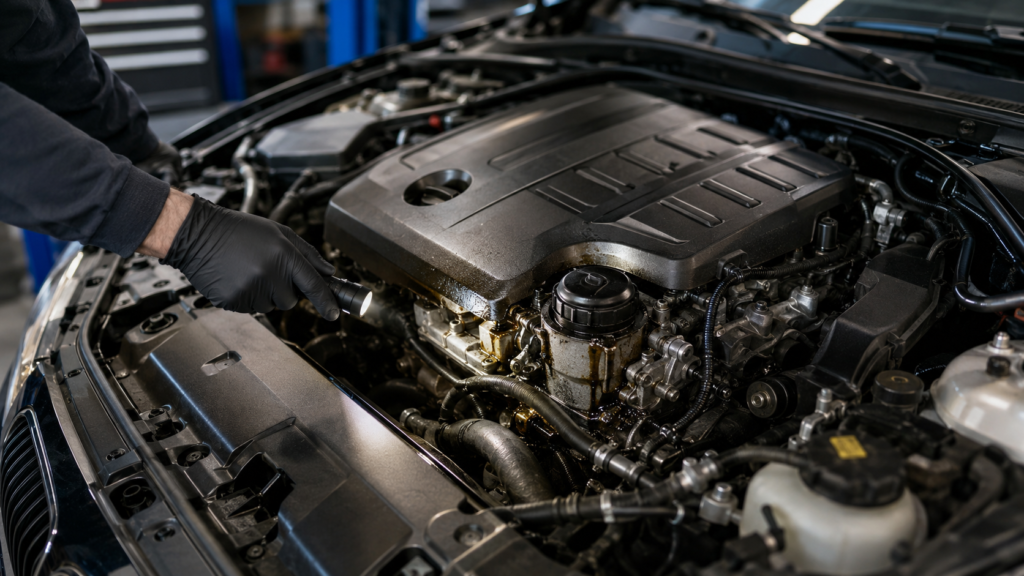
If your BMW is leaking oil, start with where you see the oil, when you smell it, and how quickly the level is dropping. Oil can travel down the engine and make the lowest wet area look like the source even when the leak actually began much higher up.
| What You Notice | Possible Source | Priority |
|---|---|---|
| Oil around the top or side of the engine | Valve cover or valve cover gasket | Inspect soon |
| Burning-oil smell or light smoke from engine bay | Oil leaking onto a hot engine or exhaust component | Repair soon |
| Oil around the oil filter housing | Oil filter housing, gasket, or related sealing surface | Inspect promptly |
| Oil near the serpentine belt or front of engine | Oil filter housing area or another upper-engine leak | Higher priority |
| Oil collecting along the bottom of the engine | Oil pan gasket or oil traveling down from above | Confirm source before repair |
| Oil in the spark-plug wells | Valve cover or sealing problem | Repair soon, especially with misfire symptoms |
| Fresh puddle after parking | Active external leak | Check oil level and diagnose promptly |
The table is a starting point, not a diagnosis. A BMW engine can have more than one oil leak at the same time, especially as seals and plastic components age.
Most Common BMW Oil Leak Locations
1. Valve Cover or Valve Cover Gasket Leak
The valve cover area is one of the first places to inspect when oil appears near the top of a BMW engine. Depending on the engine, the problem may involve the gasket, the valve cover itself, or another sealing component integrated into the cover assembly.
Common clues include:
- Oil visible around the edge of the valve cover
- Burning-oil smell after driving
- Smoke from oil reaching a hot surface
- Oil running down the side of the engine
- Oil around the ignition coils or inside the spark-plug wells
Do not automatically assume the visible gasket is the only part required. On some BMW engines, age and heat can affect the cover itself, so the exact repair should be confirmed before ordering parts.
If the leak is confirmed at the valve cover, see our BMW valve cover gasket replacement cost guide for dealer, independent-shop, and DIY pricing, plus when replacing the complete valve cover makes more sense than installing another gasket.
2. Oil Filter Housing Leak
Another important BMW oil leak location is the oil filter housing area. A leak here may begin around the housing, gasket, oil cooler connection, or related sealing surface depending on the engine design.
This leak deserves extra attention when oil is migrating toward the front accessory drive. Oil around the serpentine belt, pulleys, or tensioner should not be treated the same way as a light seep in an isolated area.
BMW has documented oil filter housing leakage on certain applications, which is another reason to diagnose the exact engine and housing design rather than assuming all BMW oil leaks are identical.
3. Oil Pan Gasket Leak
An oil pan gasket leak normally appears lower on the engine, but this is also one of the easiest leaks to misdiagnose. Oil leaking from the valve cover or oil filter housing can travel downward and make the oil pan look wet even when the pan is not the original source.
That matters because BMW oil pan repairs can be labor-intensive. Depending on the chassis and drivetrain, access may require moving or supporting other components, which can make labor much more expensive than the gasket itself.
Before authorizing an oil pan gasket replacement, make sure the technician has identified the highest point where fresh oil appears.
4. Other Possible BMW Oil Leak Sources
The valve cover, oil filter housing, and oil pan are common areas, but they are not the only possible sources. Depending on the engine, oil can also escape from seals, sensors, oil lines, turbocharger-related oil connections, timing-area components, or other engine sealing surfaces.
This is why a broad diagnosis is more useful than ordering the gasket associated with whichever area happens to look wet from underneath the car.
BMW Oil Leak Repair Cost
BMW oil leak repair cost varies widely because the inexpensive seal or gasket is often not what makes the repair expensive. Labor access can be the biggest part of the bill.
The following are broad planning ranges rather than quotes. BMW model, engine, xDrive vs rear-wheel drive, local labor rates, related damage, and whether the entire housing or cover must be replaced can change the final cost substantially.
| Common BMW Oil Leak Repair | Typical Shop Planning Range | Why Cost Varies |
|---|---|---|
| Valve cover / valve cover gasket | About $600–$1,200+ | Engine access, gasket-only vs complete cover, additional seals and hardware |
| Oil filter housing / gasket area | About $350–$900+ | Engine design, gasket vs housing replacement, coolant/oil service, access |
| Oil pan gasket | About $800–$2,500+ | Chassis, xDrive, subframe/access requirements, labor rate |
| Simple external seal or connection | Varies considerably | Leak location and access matter more than the price of the seal |
Those ranges are intentionally broad. For example, an oil pan gasket on a rear-wheel-drive sedan can be a very different labor job from an oil pan repair on an xDrive BMW or larger SUV.
Before approving an expensive repair, ask the shop to identify the exact source of the fresh oil and explain whether the repair involves only a gasket or a larger housing or cover assembly.
How Serious Is a BMW Oil Leak?
Not every BMW oil leak has the same urgency. A small seep with a stable oil level is different from an active leak reaching a hot exhaust component or the accessory belt.
| Leak Situation | General Priority | Why |
|---|---|---|
| Light seep with no measurable oil loss | Monitor and schedule diagnosis | May remain minor, but source should still be identified |
| Burning-oil smell | Repair soon | Oil may be contacting a hot engine or exhaust surface |
| Oil in spark-plug wells | Repair soon | Can affect ignition components and contribute to drivability problems |
| Oil around belt or pulleys | Higher priority | Contamination can create additional problems beyond the original leak |
| Fresh drops or puddles under car | Prompt diagnosis | Indicates an active external leak |
| Oil warning / rapidly falling oil level | Urgent | Engine lubrication can be compromised if oil level becomes too low |
If the oil level is dropping quickly, an oil-pressure or oil-level warning appears, or the engine is losing a significant amount of oil, stop treating the problem as a cosmetic leak and have it diagnosed promptly.
BMW Oil Leak Symptoms: Where You See Oil Matters
Oil Leaking From the Top of the Engine
Fresh oil near the upper engine should make the valve cover area one of your first inspection points. Follow the wet area carefully rather than assuming the lowest drip is the source.
Burning Oil Smell With No Puddle
A BMW can leak enough oil to create a burning smell without leaving a large puddle on the driveway. Oil leaking from an upper engine seal may reach a hot surface and burn off before much reaches the ground.
Oil Under the Front of the Engine
Oil near the front accessory drive deserves closer inspection. Check the oil filter housing area and trace the leak upward before assuming the oil pan is responsible.
Oil Under the Center of the Car
Oil collecting underneath the engine may point toward the oil pan, but BMW undertrays can spread oil away from the original leak. Remove or inspect around the undertray when necessary so you can see where the oil first reaches the bottom of the engine.
Oil in the Spark-Plug Wells
Oil around the ignition coils or spark plugs points toward an upper-engine sealing problem rather than an oil pan leak. This matters because oil contamination can affect ignition components and may appear alongside rough running or misfire symptoms.
If the car is also shaking, hesitating, or storing misfire codes, see our BMW misfire diagnosis guide.
BMW Oil Leaks by Engine Family
The engine family matters when diagnosing a BMW oil leak. A 328i with an N20 does not necessarily have the same leak points, packaging, or repair procedure as a newer 330i with a B48 or an X5 with a six-cylinder engine.
N20 and N26 BMW Oil Leaks
On N20/N26-powered BMWs, inspect the upper engine and oil filter housing area carefully when oil is visible around the front or side of the engine. Valve-cover-area leaks and lower-engine leaks should also be diagnosed based on the exact location of fresh oil.
The N20 deserves special attention because searches for BMW N20 oil leaks are common enough that we cover that engine separately in a dedicated guide.
If your BMW uses the turbocharged N20 four-cylinder, see our BMW N20 oil leak guide for the common leak locations, including the valve cover, oil filter housing, vacuum pump area and oil pan, plus what to inspect first.
N55 BMW Oil Leaks
For N55-powered BMWs, the same general diagnostic rule applies: start at the highest fresh-oil location and inspect the valve cover area, oil filter housing area, and lower engine before deciding what needs replacement.
B48 and B58 BMW Oil Leaks
B48 and B58 engines use different components and packaging than earlier BMW engines, so do not assume that a repair guide or gasket recommendation for an N20, N55, or older engine automatically applies.
Use the VIN, engine code, production year, and exact leak location when identifying parts or repair procedures.
BMW Oil Leaks by Model
A model name alone does not identify the repair. BMW used different engines and drivetrains across the same model line, so a 328i, 330i, X3, or X5 can have very different oil-leak causes and labor requirements depending on year and configuration.
| BMW Model | What to Confirm Before Diagnosing |
|---|---|
| BMW 328i | Model year, N20/N26 vs earlier engine, xDrive vs rear-wheel drive |
| BMW 330i | Model year, chassis generation, B48 configuration, drivetrain |
| BMW X3 | Generation, engine family, xDrive configuration |
| BMW X5 | Engine family, drivetrain, packaging and access differences |
This is especially important with oil pan repairs because drivetrain and chassis packaging can change labor time dramatically.
Can You Drive With a BMW Oil Leak?
Whether you can continue driving depends on the size and location of the leak and whether the oil level remains safe.
A minor seep with a stable oil level may give you time to schedule a repair. An active leak, rapidly dropping oil level, oil reaching the belt or exhaust, or an oil-pressure warning is a different situation.
- Check the oil level regularly while the leak remains unresolved.
- Do not ignore an oil-pressure warning.
- Do not assume topping off the oil permanently solves the problem.
- Investigate burning smells or visible smoke.
- Repair leaks contaminating belts, ignition components, or other critical parts promptly.
How to Diagnose a BMW Oil Leak Before Buying Parts
A clean engine makes oil-leak diagnosis much easier. If the entire underside is already coated in old oil, it can be difficult to distinguish the current source from years of residue.
- Check the oil level. Determine whether the car is actually losing a measurable amount of oil.
- Inspect from the top down. Oil flows downward, so start high on the engine before blaming the oil pan.
- Clean the suspected area. Removing old residue makes fresh oil easier to identify.
- Run the engine and reinspect. Look for the highest point where fresh oil begins to appear.
- Check after a short drive. Some leaks become more obvious once the engine is hot and oil pressure increases.
- Use UV dye when necessary. Dye and a UV light can help locate a slow or difficult leak when visual inspection is inconclusive.
- Confirm more than one leak is not present. Older BMWs can have multiple sealing points leaking simultaneously.
If the leak is accompanied by a check engine light, rough running, or other stored faults, a scanner can help identify secondary problems even though most external oil leaks themselves are diagnosed visually.
DIY BMW Oil Leak Repair vs Professional Repair
Some BMW oil-leak repairs are realistic DIY jobs for an experienced owner with the proper tools, service information, workspace, and mechanical experience. Others become difficult because of tight access, drivetrain components, engine support requirements, or the amount of disassembly involved.
| Potential DIY Situation | Better Candidate for a Shop |
|---|---|
| Leak source is clearly identified | Source is uncertain or multiple areas are wet |
| Repair has straightforward access | Subframe, drivetrain, or major components need to be moved |
| You have correct torque information and tools | Special tools or engine support are required |
| No secondary damage is present | Oil has contaminated belts, wiring, or other components |
| You are comfortable verifying the repair afterward | Oil loss is significant or engine safety is in question |
The biggest mistake is choosing DIY or shop repair based only on the price of the gasket. On many BMWs, access and diagnosis are the difficult parts of the job.
BMW Oil Leak FAQ
What is the most common BMW oil leak?
Valve cover, oil filter housing, and oil pan sealing areas are common places to inspect, but the most likely source depends on the BMW engine, model year, and where the fresh oil first appears. Diagnose the actual source rather than assuming every BMW leaks from the same gasket.
How much does a BMW oil leak cost to repair?
Repair cost can range from several hundred dollars to well over $2,000 depending on the leak. Valve-cover and oil-filter-housing repairs are often less labor-intensive than certain oil-pan repairs, especially on xDrive models where access can be substantially more involved.
Why does my BMW smell like burning oil?
A burning-oil smell can occur when leaking engine oil reaches a hot engine or exhaust surface. An upper-engine leak may burn off before enough oil reaches the ground to create an obvious puddle.
Why is my BMW leaking oil but there is no puddle?
A slow leak may coat the engine or undertray rather than dripping directly onto the driveway. Oil can also burn off on hot components. Inspect the engine from the top down and remove accumulated residue if necessary to locate fresh oil.
Is a BMW oil pan gasket expensive to replace?
It can be. The gasket itself may not be particularly expensive, but accessing the oil pan on some BMW chassis—especially certain xDrive applications—can require substantial labor. That is why confirming the pan is actually the leak source is important before authorizing the repair.
Can a BMW oil leak cause a misfire?
An external oil leak does not automatically cause a misfire, but oil entering the spark-plug or ignition-coil area can contribute to ignition problems. If the BMW has both an oil leak and rough-running symptoms, inspect the ignition components and scan the car rather than assuming the two problems are unrelated.
Final Recommendation
If your BMW is leaking oil, do not start by replacing whichever gasket is closest to the drip on the ground. Oil travels downward and can spread across engine covers and undertrays, making the apparent leak location misleading.
Start at the highest point where fresh oil appears, identify whether the leak is coming from the valve cover, oil filter housing, oil pan, or another component, and consider how quickly the oil level is changing. Leaks reaching belts, hot exhaust components, ignition parts, or leaving fresh puddles deserve faster attention than a minor isolated seep.
Once the source is confirmed, compare the cost and difficulty of the repair before deciding whether it makes sense as a DIY job or should go to an independent BMW specialist.