BMW Suspension Upgrades: Coilovers, Lowering Springs & Sway Bars
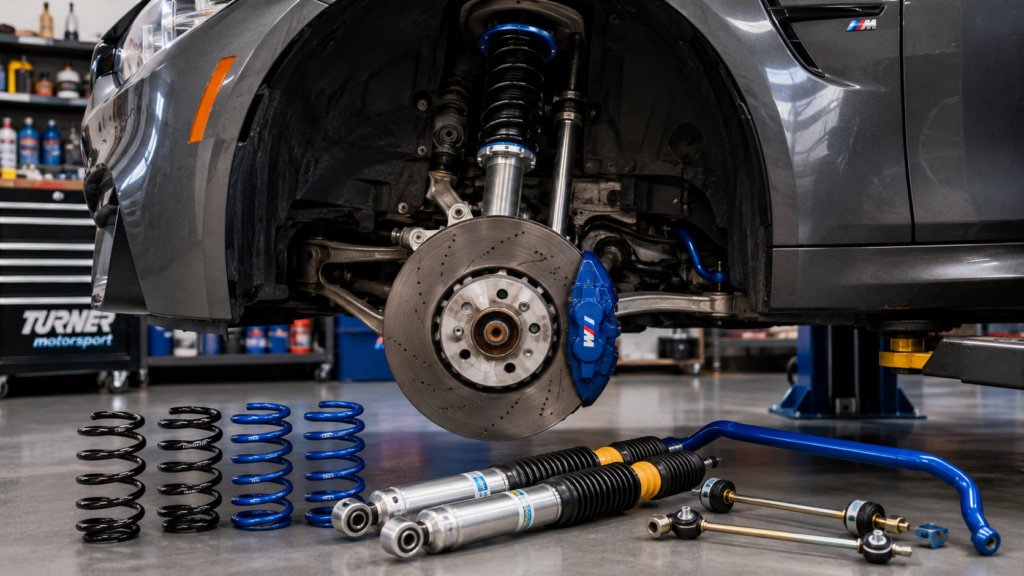
BMW suspension upgrades can completely change how a car looks and feels, but coilovers, lowering springs, sway bars, dampers, and complete suspension kits solve different problems.
If your goal is simply a lower stance, lowering springs may be enough. If you want adjustable ride height and more control over the suspension setup, coilovers make more sense. If you like the factory ride height but want less body roll in corners, sway bars may be the better place to start.
This guide compares the main BMW suspension upgrades, what each one changes, the tradeoffs for daily driving, adaptive-suspension considerations, and how to choose the right setup without making the car worse to live with.
This page contains affiliate links. If you buy through them, we may earn a commission at no extra cost to you.
BMW Suspension Upgrades: Quick Answer
The best BMW suspension upgrade depends on what you are trying to improve.
| Your Goal | Best Starting Point | Main Tradeoff |
|---|---|---|
| Lower the car without replacing everything | Lowering springs | Ride quality and damper compatibility matter |
| Adjust ride height | Coilovers | Higher cost and more setup choices |
| Reduce body roll without lowering much | Sway bars | Can change handling balance |
| Replace worn shocks while improving control | Performance dampers or matched suspension kit | More expensive than springs alone |
| Build a more track-focused setup | Quality adjustable coilovers | Comfort, clearance, and maintenance can suffer |
| Improve a daily driver without going extreme | Mild springs, matched dampers, or sway bars | Need to choose parts around your priorities |
For most street-driven BMWs, the best suspension is not the stiffest or lowest setup. It is the one that improves the part of the car you actually want to change without creating new problems with ride quality, tire clearance, alignment, or everyday usability.
1. BMW Lowering Springs
BMW lowering springs are one of the simplest ways to reduce ride height and tighten up the appearance of the car without installing a complete coilover system.
The springs replace the factory springs while the rest of the suspension remains largely intact. Depending on the specific product, the drop may be subtle or noticeably more aggressive.
Why Choose Lowering Springs?
- Lower cost than most coilover systems
- Cleaner stance and reduced wheel gap
- Relatively straightforward upgrade
- Can sharpen body control when properly matched to the car
- Lets you retain more of the factory suspension system
Lowering Spring Tradeoffs
The biggest limitation is that the ride height is normally fixed. Once the springs are installed, you do not have the same height adjustment available with most coilover systems.
Spring rate and drop also need to work well with the dampers. A mild spring on healthy compatible dampers can be very different from combining aggressive lowering with old or poorly matched shocks.
If your BMW already has high-mileage dampers, installing lowering springs without considering their condition can mean doing much of the same labor again later when the dampers need replacement.
If lowering springs sound like the right fit for your build, read our BMW lowering springs guide for a closer look at ride quality, drop, factory dampers, adaptive suspension, alignment, and the pros and cons for a street-driven BMW.
2. BMW Coilovers
BMW coilovers combine springs and dampers into a suspension system designed around adjustable ride height. Some systems also provide additional adjustments such as damping, depending on the kit.
This gives you much more control over the final stance and suspension setup than a conventional fixed lowering spring.
Why Choose Coilovers?
- Adjustable ride height
- Spring and damper designed as a system
- Large range of street and performance options
- Ability to fine-tune stance
- Some kits offer adjustable damping
- Better foundation for owners who expect to keep modifying the car
Coilover Tradeoffs
Coilovers are not automatically better just because they offer more adjustment. Product quality, spring rates, damping, installed ride height, wheel and tire clearance, and setup all affect the result.
A well-designed street coilover can work very well on a daily-driven BMW. A poorly chosen or excessively low setup can make the car harsher, reduce suspension travel, create clearance problems, and become frustrating on rough roads.
If your only goal is a modest drop, paying for a highly adjustable coilover system may be unnecessary. But if you want to control the exact ride height or expect the suspension setup to evolve, coilovers become much easier to justify.
If coilovers are the direction you are considering, read our BMW coilovers guide for a closer look at ride quality, cost, lowering, adjustable damping, EDC compatibility, alignment, and what matters most on a street-driven BMW.
BMW Lowering Springs vs Coilovers
The BMW lowering springs vs coilovers decision usually comes down to budget, adjustability, and how much control you want over the final setup.
| Feature | Lowering Springs | Coilovers |
|---|---|---|
| Initial cost | Lower | Higher |
| Ride-height adjustment | Usually fixed | Yes on most systems |
| Damper included | No | Usually yes |
| Installation complexity | Moderate | Moderate to higher |
| Ability to fine-tune stance | Limited | Much better |
| Daily-driver potential | Very good with the right spring | Very good with the right street-oriented kit |
| Track-oriented options | Limited | Much broader range |
| Best for | Simple fixed drop | Owners wanting adjustment and a complete system |
For a mostly stock daily driver, lowering springs can be the better value if you already like the overall suspension behavior and simply want a modest drop.
Choose coilovers when ride-height adjustment, a complete spring-and-damper package, or future suspension tuning matters more than minimizing cost.
3. BMW Sway Bars
BMW sway bars, also called anti-roll bars, approach handling differently from springs and coilovers. Their main job is to resist body roll as the car corners.
That makes sway bars interesting for owners who want the BMW to feel flatter and more responsive through turns without necessarily lowering the car.
Why Choose Sway Bars?
- Reduce body roll during cornering
- Can sharpen handling response
- Do not require lowering the car
- Can work with otherwise stock suspension
- Useful for changing handling balance when properly selected
Sway bars should not be chosen only by buying the largest bar available. Front and rear roll stiffness affect the balance of the chassis, so a matched application-specific setup is usually a better approach than treating sway bars as purely a size upgrade.
4. Performance Shocks and Struts
Springs support the vehicle and influence ride height and suspension movement, while the dampers—commonly called shocks and struts—control how quickly that movement occurs.
If your BMW’s original dampers are worn, replacing them can improve control even without dramatically lowering the car.
Performance dampers become especially relevant when you want to use lowering springs but also want the spring and damper characteristics to work well together.
This can be a smart middle ground for a street BMW: more controlled suspension behavior without committing to ride-height-adjustable coilovers.
5. Complete BMW Suspension Kits
A BMW suspension kit can bundle components that were designed to work together rather than mixing unrelated springs and dampers.
Depending on the kit, that may include:
- Springs and dampers
- Height-adjustable coilovers
- Springs and sway bars
- Mounts or related hardware
- Application-specific components for a particular chassis
A matched kit can remove some of the guesswork, especially for owners who want a balanced street setup instead of building a suspension one component at a time.
Which BMW Suspension Upgrade Should You Choose?
| If This Describes You… | Start Here |
|---|---|
| I mainly want to close the wheel gap | Mild lowering springs |
| I want to choose the exact ride height | Coilovers |
| I want less body roll but do not want to lower the car | Sway bars |
| My original shocks are worn | Quality replacement or performance dampers |
| I want springs and dampers engineered together | Matched suspension kit |
| I want a street car that may see occasional track use | Quality street-performance coilovers or matched suspension setup |
| I care more about comfort than stance | Keep the drop mild and avoid overly aggressive spring rates |
BMW Suspension Upgrades for Daily Driving
A suspension setup that feels exciting on one smooth road can become tiring when you drive it every day over potholes, expansion joints, steep driveways, and broken pavement.
For a street-driven BMW, consider more than how low the car looks.
- How rough are the roads where you live?
- Do you regularly carry passengers?
- Do you use the car year-round?
- Will the car clear your driveway?
- Do you want more road feel or more comfort?
- Are you willing to adjust and maintain a more complex suspension setup?
- Are your wheels and tires already close to the fenders?
For most daily drivers, moderate suspension changes usually make more sense than chasing the lowest possible ride height.
Street vs Track BMW Suspension
Street and track suspension setups have different priorities, which is why a track-focused suspension is not automatically an upgrade for a daily driver.
| Street Priorities | Track Priorities |
|---|---|
| Ride quality | Body and wheel control |
| Ground clearance | Lower center of gravity when appropriate |
| Low noise | Performance over isolation |
| Long service intervals | Adjustability and setup options |
| Passenger comfort | Consistency during hard driving |
| Works well across bad roads | Optimized for a smoother controlled environment |
A BMW that spends nearly all of its time on public roads usually benefits more from a well-controlled street setup than from copying a suspension configuration designed around track use.
What About BMW Adaptive Suspension?
If your BMW has electronically controlled or adaptive dampers, confirm compatibility before ordering suspension parts.
Some suspension upgrades are specifically designed to work with the factory electronic dampers, while others replace more of the original system. The correct approach depends on the BMW chassis, suspension option, and specific product.
Do not assume that a suspension part fitting the same model without adaptive suspension automatically works the same way on an adaptive-equipped car.
Use the VIN, chassis, model year, drivetrain, and suspension option when checking fitment.
Do You Need an Alignment After Lowering a BMW?
After changing ride height or replacing major suspension components, the wheel alignment should be checked.
Changing suspension geometry can affect alignment settings and tire wear. Even when the car appears to drive straight, you do not want to discover several thousand miles later that the inside edges of expensive BMW tires are wearing rapidly.
Let the suspension settle as appropriate for the installed components, then have the alignment measured and adjusted to suit the intended use of the car.
Suspension Upgrade Mistakes to Avoid
Going Too Low
A lower stance can look good while parked and still be a bad setup to drive. Excessive lowering can reduce usable suspension travel and create problems with ramps, driveways, tires, and underbody clearance.
Buying Only on Price
Suspension controls how the tires stay connected to the road. This is not an area where the cheapest adjustable kit is automatically a bargain.
Ignoring Worn Factory Parts
A new spring or coilover does not repair worn bushings, damaged mounts, loose ball joints, bad wheel bearings, or other aging suspension components.
Inspect the surrounding suspension before modifying it so you are not trying to tune around an existing mechanical problem.
Ignoring Wheel and Tire Clearance
Lowering the car changes how the wheel and tire move relative to the fender and suspension. Aggressive wheel offsets, wide tires, spacers, and lowering all need to be considered together.
Skipping the Alignment
Do not spend money upgrading the suspension and then ignore alignment. Poor alignment can reduce handling quality and shorten tire life.
Building for the Track When You Drive on the Street
Be realistic about how the BMW is actually used. A suspension setup does not need to be uncomfortable to be a meaningful performance upgrade.
BMW Suspension Upgrade FAQ
What is the best BMW suspension upgrade?
There is no single best upgrade. Lowering springs are a good choice for a simple fixed drop, coilovers offer adjustable ride height, sway bars target body roll, and upgraded dampers can improve control when the original shocks are worn or when they are matched with performance springs.
Are coilovers worth it on a daily-driven BMW?
They can be if you value adjustable ride height or want a complete spring-and-damper system. Choose a street-oriented kit and avoid setting the car unnecessarily low if comfort and everyday usability matter.
Are lowering springs better than coilovers?
Lowering springs are usually less expensive and simpler when you only want a modest fixed drop. Coilovers offer more adjustment and normally replace both the spring and damper as a matched system. The better choice depends on what you want from the car.
Do BMW sway bars make the ride harsher?
Sway bars primarily affect how the suspension resists roll when the left and right sides move differently. The effect on ride quality depends on the bar design, road surface, suspension setup, and application. Choose an application-specific setup instead of assuming the stiffest option is best.
Can I install lowering springs on stock BMW shocks?
Some lowering springs are designed to work with compatible factory dampers, but that does not mean every spring is appropriate for every stock shock. Check the manufacturer’s application guidance and consider damper age and condition before installation.
Will lowering my BMW require an alignment?
Ride-height changes can alter suspension geometry, so alignment should be checked after lowering or substantial suspension work. This helps protect handling and tire wear.
Final Recommendation
Start with the problem you are trying to solve instead of buying suspension parts because they are popular.
If you mainly want a lower stance at a reasonable cost, start with quality lowering springs. If you want ride-height adjustment and a complete spring-and-damper system, look at quality coilovers. If you are happy with the ride height but want less body roll, sway bars deserve serious consideration.
For a daily-driven BMW, keep enough suspension travel and ground clearance to enjoy the car on the roads you actually drive. Fitment, adaptive-suspension compatibility, tire clearance, damper condition, and alignment matter just as much as the brand name printed on the new parts.
The best suspension upgrade is the one that makes your BMW better every time you drive it—not just lower when it is parked.