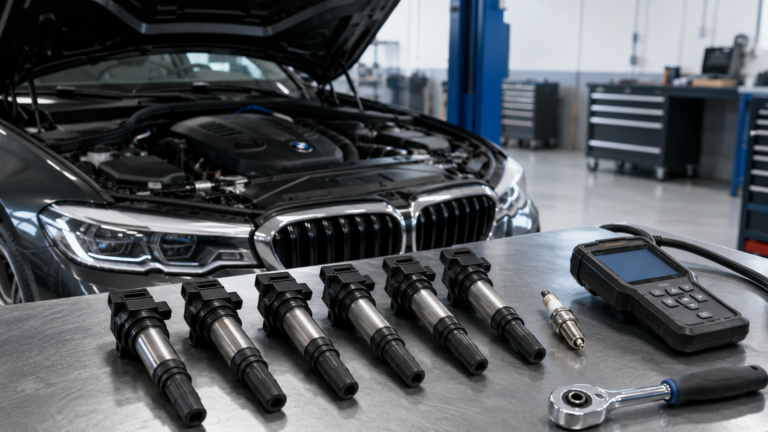
BMW Misfire: Causes, Symptoms, Diagnosis & Fixes
A BMW misfire can cause rough idle, shaking, hesitation, loss of power, or a check engine light. The most common causes are ignition coils, worn spark plugs, fuel injector problems, vacuum or intake leaks, and less commonly mechanical problems such as low compression.
The fastest way to diagnose a BMW engine misfire is to stop guessing and work through the problem in order: read the fault codes, identify when the misfire happens, inspect obvious air and ignition problems, and test the affected cylinder before replacing parts.
This guide covers the most common BMW misfire symptoms and causes, what P0300 and cylinder-specific misfire codes mean, how to perform basic DIY checks, and when the problem needs professional diagnosis.
This page contains affiliate links. If you buy through them, we may earn a commission at no extra cost to you.
BMW Misfire: Quick Diagnosis
| What You Notice | Possible Direction | What to Check First |
|---|---|---|
| Rough or shaking idle | Coil, spark plug, vacuum leak, injector | Read codes and identify whether one cylinder or several are affected |
| Misfire under acceleration or load | Ignition coil, spark plug, fuel delivery | Check cylinder-specific codes and ignition components |
| Misfire mainly when cold | Ignition, injector, air leak, or mechanical issue | Compare cold-start behavior with warm operation and scan for stored faults |
| P0301–P0306 code | Specific cylinder misfire | Start diagnosis on the cylinder identified by the code |
| P0300 code | Random or multiple-cylinder misfire | Look for problems that can affect more than one cylinder |
| Flashing check engine light | Active/severe misfire | Reduce load and address the problem promptly |
What Is a BMW Engine Misfire?
An engine misfire happens when one or more cylinders do not complete combustion normally. When that happens, the engine can run unevenly and the BMW’s engine-management system may store fault codes identifying the affected cylinder or the type of problem it detected.
A misfire does not automatically mean the engine itself is damaged. Many BMW misfires come from ignition or air/fuel problems that can be diagnosed without major engine work. The important part is identifying the actual cause before replacing components.
Common BMW Misfire Symptoms
BMW misfire symptoms can overlap with vacuum leaks, fuel problems, worn engine mounts, transmission behavior, and other faults, so the way the problem behaves matters.
- Rough or uneven idle
- Shaking or vibration while stopped
- Hesitation when accelerating
- Loss of power or bogging under load
- Engine vibration that changes with RPM
- Steady or flashing check engine light
- Poor fuel economy
- Fuel smell from the exhaust in more severe cases
Misfire at Idle vs Under Acceleration
When the misfire happens can help narrow the diagnosis.
| When It Happens | What It Can Suggest |
|---|---|
| Mainly at idle | Vacuum or intake leak, injector issue, ignition problem, or another air/fuel imbalance |
| Mostly under acceleration | Weak ignition coil, worn spark plug, or fuel-delivery problem becomes more likely |
| Only when cold | Ignition, fueling, air leak, or mechanical issues that improve as the engine warms |
| Constant at all speeds | Persistent cylinder-specific ignition, injector, wiring, or mechanical fault |
These patterns are clues rather than proof. Fault codes and component testing should confirm the diagnosis before you buy parts.
BMW Misfire Codes: P0300 and P0301–P0306
Standard OBD2 misfire codes can quickly tell you whether the computer sees a random misfire or a problem associated with a particular cylinder.
| Code | Basic Meaning |
|---|---|
| P0300 | Random or multiple-cylinder misfire detected |
| P0301 | Cylinder 1 misfire detected |
| P0302 | Cylinder 2 misfire detected |
| P0303 | Cylinder 3 misfire detected |
| P0304 | Cylinder 4 misfire detected |
| P0305 | Cylinder 5 misfire detected |
| P0306 | Cylinder 6 misfire detected |
A cylinder-specific code is useful because you can begin testing that cylinder instead of replacing parts across the entire engine. P0300 requires a wider diagnosis because the problem may be affecting multiple cylinders.
We are keeping this section intentionally brief. Individual P0300–P0306 codes can have several possible causes and should be diagnosed in context rather than treated as automatic confirmation of a bad ignition coil.
If your scanner shows one of these codes, see our BMW P0300–P0306 misfire code guide for the meaning of each code, likely causes, and a step-by-step diagnosis path.
Most Common BMW Misfire Causes
1. Ignition Coil Failure
Ignition coils are one of the first components worth checking when a BMW has a cylinder-specific misfire. A weak or failed coil may cause an intermittent misfire, a rough idle, or a misfire that becomes more obvious under acceleration.
Heat, age, mileage, electrical problems, and contamination can all contribute to coil problems. Oil leaking into the spark-plug area can also create ignition problems that should be corrected rather than simply replacing the coil and ignoring the leak.
If you find oil around the ignition coils or inside the spark-plug wells, use our BMW oil leak diagnosis guide to trace the leak before replacing ignition parts and ignoring the underlying problem.
If diagnosis confirms that the oil is coming from the valve-cover area, our BMW valve cover gasket replacement cost guide explains what the repair typically costs and when the complete valve cover should be replaced instead of only the gasket.
If testing confirms a failed coil, see our BMW ignition coil replacement cost guide before deciding whether to replace one coil or a full set.
2. Worn or Fouled Spark Plugs
Worn, damaged, incorrectly gapped, or fouled spark plugs can create weak combustion and misfires. Problems may become especially noticeable under acceleration when the ignition system is working harder.
If the plugs are overdue or their condition is questionable, inspect them rather than assuming the ignition coil is automatically responsible.
See our BMW spark plug replacement cost guide for typical dealer, independent-shop, and DIY costs.
3. Fuel Injector Problems
A faulty, clogged, or electrically malfunctioning fuel injector can prevent a cylinder from receiving the correct amount of fuel. Injector-related problems can cause rough running, hesitation, poor performance, and cylinder-specific faults.
If ignition components test correctly but the same cylinder continues to misfire, fuel delivery becomes a more important part of the diagnosis.
4. Vacuum or Intake Leaks
Unmetered air entering the engine can disturb the air-fuel mixture and create rough idle, lean conditions, or misfire-like behavior.
- Loose or disconnected intake connections
- Cracked intake or vacuum hoses
- PCV-related leaks
- Connections disturbed during recent intake work
A vacuum or intake leak often affects more than one cylinder, although the exact fault pattern depends on where the leak occurs.
5. Fuel Pressure or Fuel Delivery Problems
Fuel-pressure problems can create hesitation, stumbling, or misfires when the engine is under load. If several cylinders are affected and the basic ignition checks do not explain the problem, the diagnosis may need to move beyond individual coils and plugs.
6. Low Compression or Mechanical Problems
Less common but more serious causes include valve problems, compression loss, piston or ring issues, and other internal engine faults.
A persistent cylinder misfire that remains after ignition, fuel, and air-related problems have been ruled out may require compression, leak-down, or other mechanical testing.
How to Diagnose a BMW Misfire Step by Step
The best way to avoid wasting money is to diagnose the problem in a logical order.
Step 1: Read the Fault Codes
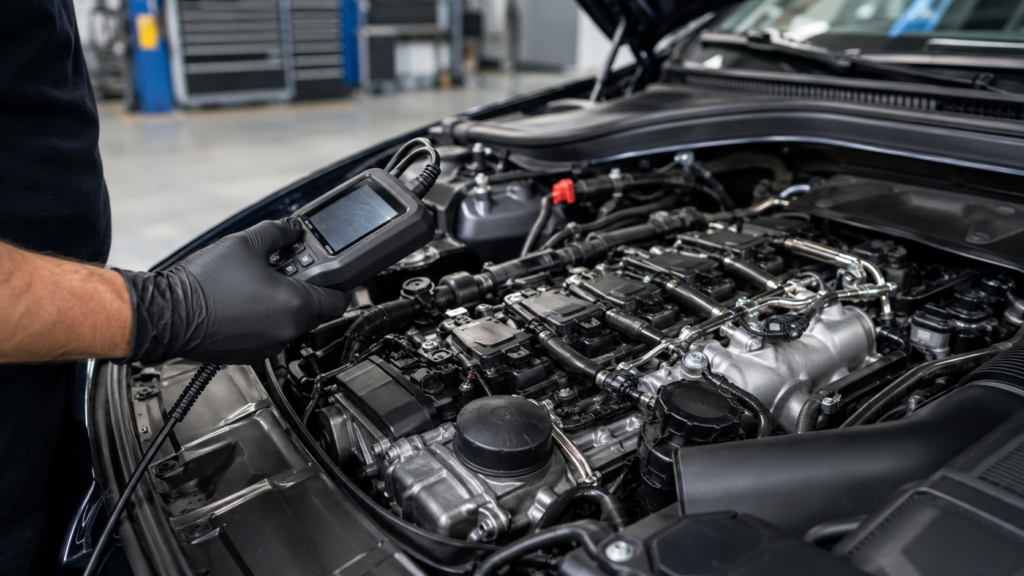
Scan the car before clearing anything. Write down the fault codes and note whether you have a random misfire or a cylinder-specific P030X code.
Also note when the problem happens: idle, cold start, acceleration, highway cruising, or all the time.
Step 2: Do a Quick Visual Inspection
Before removing parts, spend a few minutes checking for obvious problems:
- Loose intake clamps
- Disconnected hoses
- Cracked vacuum lines
- Oil around the spark plugs or coils
- Ignition-coil connectors that are not fully seated
- Wiring that was recently disturbed during other work
An obvious loose connection can save you from replacing perfectly good ignition parts.
Step 3: Use the Coil-Swap Test for a Cylinder-Specific Misfire
If you have a cylinder-specific code such as P0302 or P0303, swapping ignition coils can be a useful DIY diagnostic test.
- Identify the cylinder reporting the misfire.
- Move that cylinder’s ignition coil to another cylinder.
- Reinstall the components correctly.
- Clear the codes after recording them.
- Run or drive the car as appropriate and scan it again.
If the misfire follows the coil to the new cylinder, the coil becomes a strong suspect. If the misfire stays on the original cylinder, keep diagnosing instead of immediately buying another coil.
Step 4: Inspect the Spark Plug
If the coil does not explain the problem, inspect the plug on the affected cylinder. Look for excessive wear, fouling, oil contamination, damage, or another condition that could interfere with ignition.
Step 5: Move Beyond Ignition if the Misfire Remains
If the coil and spark plug do not explain the problem, the next checks may involve injectors, fuel pressure, intake or vacuum leaks, wiring, or mechanical condition.
This is where a systematic diagnosis matters most. Replacing additional ignition parts simply because they are easy to reach can become expensive without solving the problem.
Misfire vs Vacuum Leak or Fuel Problem
A rough-running BMW does not automatically have a bad ignition coil.
| Pattern | Possible Direction |
|---|---|
| Single-cylinder code that follows a swapped coil | Ignition coil is a strong suspect |
| Rough idle plus lean codes | Vacuum or intake leak becomes more likely |
| Multiple cylinders stumble under load | Fuel delivery, air/fuel, or other shared-system problem deserves attention |
| Same cylinder misfires after coil and plug checks | Injector, wiring, compression, or another cylinder-specific problem may be involved |
The pattern narrows the search, but scanning and testing should confirm the cause.
Is It Safe to Drive With a BMW Misfire?
The severity matters. A mild intermittent stumble is different from an engine that is shaking badly with a flashing check engine light.
A flashing check engine light can accompany an active misfire severe enough to send unburned fuel into the exhaust, which can overheat and damage the catalytic converter. If the engine is running very poorly, power loss is severe, or the check engine light is flashing, avoid continuing to drive the car hard while the problem remains unresolved.
If you are unsure what the warning itself means, see our BMW check engine light guide.
DIY BMW Misfire Repairs vs Professional Diagnosis
Some BMW misfire problems are reasonable DIY jobs when the diagnosis is clear.
| Often DIY-Friendly | Usually Needs More Diagnosis |
|---|---|
| Reading fault codes | Persistent multiple-cylinder misfires |
| Visual inspection | Injector diagnosis |
| Coil-swap testing | Fuel-pressure problems |
| Spark plug replacement | Compression or mechanical faults |
| Ignition coil replacement after confirmation | Misfire that remains after basic ignition checks |
The goal is not to replace the easiest part first. It is to prove which system is causing the misfire before spending money.
BMW Misfire FAQ
What is the most common cause of a BMW misfire?
Ignition coils and spark plugs are common causes, but a BMW misfire can also come from injectors, vacuum or intake leaks, fuel-delivery problems, wiring, or mechanical issues. Fault codes and testing should determine the actual cause.
What does a BMW misfire feel like?
A misfire can feel like a rough or shaking idle, hesitation, stumbling during acceleration, reduced power, or vibration that changes with engine speed. Some misfires are intermittent and only appear under load.
Can a bad ignition coil cause a BMW misfire?
Yes. A weak or failed ignition coil can cause a cylinder-specific misfire. When appropriate, moving the suspected coil to another cylinder and checking whether the misfire follows it can help confirm the diagnosis.
What does BMW code P0300 mean?
P0300 indicates that the engine computer detected random or multiple-cylinder misfires. Unlike a cylinder-specific P0301–P0306 code, it does not point to only one cylinder.
Should I replace all BMW ignition coils if one fails?
Not automatically. The decision depends on mileage, age, whether other coils are showing problems, labor involved, and whether testing confirms only one failed coil. See our BMW ignition coil replacement cost guide for the one-coil vs full-set decision.
Final Recommendation
If your BMW is misfiring, start with the fault codes and symptom pattern rather than replacing coils, plugs, or injectors at random. A cylinder-specific code gives you a logical place to begin, while a random or multiple-cylinder misfire may require a wider diagnosis.
For a DIY owner, the best first tools are a capable scanner, a basic visual inspection, and targeted testing such as a coil swap when the fault pattern supports it. If the misfire remains after the basic ignition checks or the engine is running severely rough, move to deeper fuel, air, electrical, or mechanical diagnosis.
Related BMW Diagnostic Guides
- Best BMW Diagnostic Tool for DIY Owners
- BMW Scanner vs OBD2 Scanner: What’s the Difference?
- BMW Check Engine Light: Common Causes, Codes, and Fixes
- BMW Ignition Coil Replacement Cost: One Coil vs Full Set
- BMW Spark Plug Replacement Cost by Model
Final Thoughts
BMW misfires are common, but they’re rarely mysterious when approached systematically. Understanding the most frequent causes helps owners identify problems early, avoid unnecessary repairs, and protect engine components.
Early diagnosis and targeted repairs are the best way to keep a BMW running smoothly and reliably.