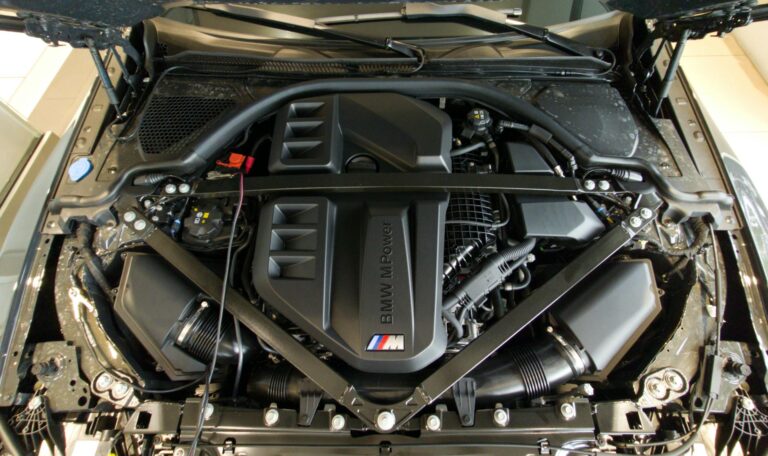
BMW Fault Codes: Common Check Engine & OBD2 Codes Explained
BMW fault codes can turn a vague check engine light into a much more useful starting point. Instead of guessing which part failed, a diagnostic scanner can show the trouble code stored by the car and help narrow the problem to a particular system or cylinder.
This BMW fault code guide covers common check engine and OBD2 codes including P0171, P0174, P0300, P0301–P0306, P0420, P0430, P0455, P0442, P0012, P0015, and P0128. For each code, we explain what it means, common BMW-related causes, and what to check before replacing parts.
These are standardized OBD2 powertrain codes commonly encountered on BMWs. BMW control modules can also store manufacturer-specific faults that a basic OBD2 reader may not display, so deeper problems may require a BMW-capable diagnostic tool.
This page contains affiliate links. If you buy through them, we may earn a commission at no extra cost to you.
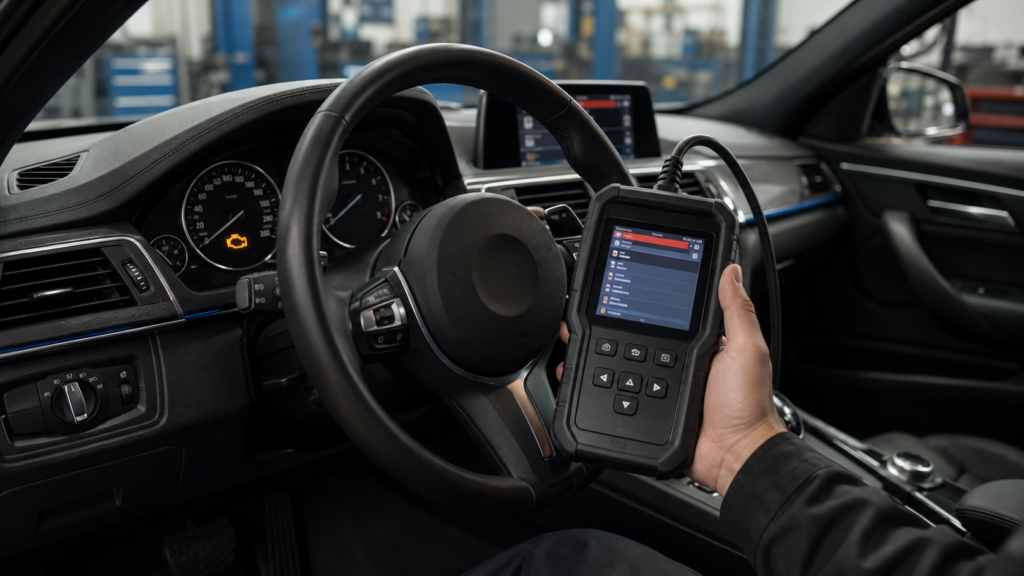
BMW Fault Codes: Quick Answer
A BMW fault code tells you what condition the engine computer detected, not necessarily which part needs to be replaced. For example, a lean code can come from an intake leak, airflow problem, or fuel-delivery issue, while a cylinder misfire code can come from a coil, spark plug, injector, wiring, or mechanical problem.
Read the code first, look at the symptoms and available live data, and then test the likely causes. Treat the code as the beginning of the diagnosis rather than a parts-shopping list.
BMW Fault Code List: Quick Reference
| BMW / OBD2 Code | Basic Meaning | First Area to Check |
|---|---|---|
| P0171 | System too lean — Bank 1 | Intake/vacuum leaks, PCV system, MAF, fuel delivery |
| P0174 | System too lean — Bank 2 | Intake/vacuum leaks, PCV system, MAF, fuel delivery |
| P0300 | Random or multiple-cylinder misfire | Coils, plugs, air leaks, fueling, shared-system faults |
| P0301–P0306 | Misfire on a specific cylinder | Coil, spark plug, injector, wiring, compression |
| P0420 | Catalyst efficiency below threshold — Bank 1 | Misfires, exhaust leaks, O2 sensor data, catalyst condition |
| P0430 | Catalyst efficiency below threshold — Bank 2 | Misfires, exhaust leaks, O2 sensor data, catalyst condition |
| P0455 | Large EVAP system leak detected | Fuel cap, EVAP lines, purge/vent system |
| P0442 | Small EVAP system leak detected | Fuel cap, small hose leaks, purge/vent system |
| P0012 | “A” camshaft timing over-retarded — Bank 1 | Oil condition/level, VANOS control, sensor or timing issue |
| P0015 | “B” camshaft timing over-retarded — Bank 1 | Oil condition/level, VANOS control, sensor or timing issue |
| P0128 | Coolant temperature below thermostat regulating temperature | Thermostat, coolant-temperature data, cooling system |
This is a list of common check-engine-related codes, not every fault a BMW can store. A BMW-specific scanner can reveal additional manufacturer codes and faults from modules that a basic OBD2 reader cannot access.
BMW Fault Codes vs Generic OBD2 Codes
A basic OBD2 scanner is designed primarily around standardized engine and emissions-related diagnostic trouble codes. That includes many of the P-codes in this guide.
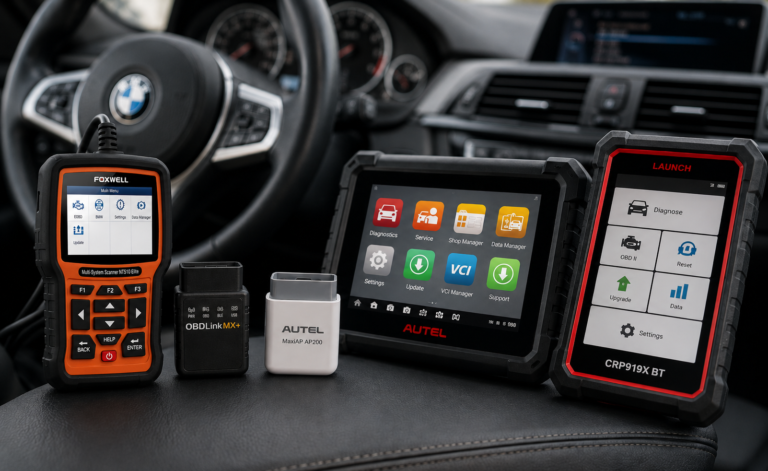
BMWs also have multiple control modules beyond the engine-management system. Depending on the vehicle and scanner, BMW-specific diagnostic tools may provide access to additional engine faults, ABS and brake-system faults, airbag/SRS faults, transmission information, battery and power-management data, service functions, and other module-specific information.
If you only need to identify a basic check engine code, a generic reader may be enough. If you plan to diagnose your BMW long-term, deeper module access and live data can make a BMW-capable scanner much more useful.
Not sure which type you need? See our BMW scanner vs OBD2 scanner comparison.
What to Do Before Diagnosing Any BMW Fault Code
- Record every code before clearing anything. One code may make more sense when you see the other codes stored with it.
- Note whether the check engine light is solid or flashing. A flashing light can accompany an active misfire and deserves faster attention.
- Write down the symptoms. Rough idle, hesitation, slow warm-up, fuel smell, poor fuel economy, or a problem that only happens under load can help narrow the cause.
- Look at freeze-frame and live data if your scanner supports them. The conditions present when a fault set can be more useful than the code alone.
- Check for recent work. If the code appeared immediately after an intake, ignition, cooling-system, exhaust, or other repair, inspect what was disturbed before buying new parts.
If you have the check engine light but have not pulled a code yet, start with our broader BMW check engine light guide.
BMW P0171 and P0174: System Too Lean
BMW P0171 and BMW P0174 are lean-condition codes. The engine-management system is seeing a condition where the air-fuel mixture requires more fuel correction than expected.
Common Causes of BMW P0171 or P0174
- Vacuum or intake leaks
- Cracked intake boots or hoses
- PCV/crankcase ventilation leaks
- Airflow measurement problems
- Loose intake connections
- Fuel-pressure or fuel-delivery problems
- Issues introduced during recent intake work
What to Check First
Start with the air side of the engine. Inspect intake boots, vacuum lines, clamps, PCV-related connections, and anything recently removed or installed. If your scanner supports live data, fuel trims can help show how strongly the engine is correcting the mixture.
If both lean codes appear together, look carefully for something capable of affecting more than one cylinder rather than immediately replacing an individual ignition component.
BMW P0300: Random or Multiple-Cylinder Misfire
BMW P0300 means the engine computer detected misfires affecting multiple cylinders or a misfire pattern that is not isolated to one specific cylinder.
Possible causes include worn spark plugs, multiple weak ignition coils, intake or vacuum leaks, fuel-delivery problems, injector problems, wiring faults, or mechanical issues.
P0300 is especially important to interpret alongside other codes. For example, P0300 combined with lean-condition codes can point the diagnosis in a different direction than P0300 accompanied by several individual cylinder codes.
For the full diagnostic workflow, see BMW Misfire: Causes, Symptoms, Diagnosis & Fixes.
BMW P0301–P0306: Cylinder-Specific Misfire Codes
P0301 through P0306 identify the cylinder where the engine computer detected the misfire:
| Code | Meaning |
|---|---|
| P0301 | Cylinder 1 misfire detected |
| P0302 | Cylinder 2 misfire detected |
| P0303 | Cylinder 3 misfire detected |
| P0304 | Cylinder 4 misfire detected |
| P0305 | Cylinder 5 misfire detected |
| P0306 | Cylinder 6 misfire detected |
For a cylinder-specific misfire, common starting points include the ignition coil and spark plug on that cylinder. A coil-swap test can help determine whether the fault follows the ignition coil, but a code that stays on the same cylinder may require further checks of the plug, injector, wiring, or mechanical condition.
Do not automatically replace a complete set of coils just because a P030X code appears. Diagnose the cylinder first.
For the complete P0300 through P0306 diagnostic workflow, see our BMW P0300–P0306 code guide, including cylinder-specific causes, coil-swap testing, spark-plug checks, injector diagnosis, and multiple-cylinder misfires.
BMW P0420 and P0430: Catalyst Efficiency Below Threshold
BMW P0420 and BMW P0430 indicate that catalyst-efficiency monitoring is outside the expected range for the applicable exhaust bank.
That does not automatically prove the catalytic converter itself needs replacement.
Possible Causes
- A catalytic converter that is no longer performing efficiently
- Exhaust leaks affecting sensor readings
- Oxygen-sensor problems
- Long-term or severe misfires that have damaged the catalyst
- Exhaust modifications that affect catalyst monitoring
What to Check First
If misfire codes are also present, address the misfire before condemning the catalytic converter. Inspect for exhaust leaks and review upstream and downstream oxygen-sensor behavior when appropriate.
If the code appeared after modifying the exhaust near the emissions-monitoring components, see our BMW downpipe guide for more on check engine light risk.
BMW P0455 and P0442: EVAP Leak Codes
BMW P0455 indicates a larger leak in the evaporative-emissions system, while BMW P0442 indicates a smaller leak.
The EVAP system controls fuel vapor rather than engine combustion directly, so these codes can appear even when the BMW seems to drive normally.
Common Things to Check
- Loose, damaged, or poorly sealing fuel cap
- Cracked or disconnected EVAP hoses
- Purge-valve problems
- Vent-valve problems
- Leaks elsewhere in the vapor-recovery system
Start with the simple visual checks, but small EVAP leaks can be difficult to locate without a smoke test or additional diagnostic equipment.
BMW P0012 and P0015: Camshaft Timing Over-Retarded
BMW P0012 and BMW P0015 relate to camshaft timing that is more retarded than the engine-management system expects. In generic OBD2 terminology, P0012 refers to the “A” camshaft and P0015 refers to the “B” camshaft on Bank 1.
On BMW engines with variable camshaft timing, these codes can involve the oil supply and VANOS control system, but the exact cause depends on the engine.
Possible Causes
- Low engine-oil level
- Incorrect, degraded, or contaminated oil
- Restricted oil flow
- VANOS solenoid or actuator-control problems
- Camshaft-position sensor or wiring problems
- Mechanical timing problems
What to Check First
Verify the engine-oil level and maintenance history first. Then use the exact BMW engine and fault information to determine whether VANOS control, sensors, wiring, oil flow, or mechanical timing needs additional testing.
Do not treat P0012 or P0015 as automatic proof that a VANOS solenoid needs replacement. The code describes the timing condition the computer detected; diagnosis is still required to find the cause.
BMW P0128: Coolant Temperature Below Thermostat Regulating Temperature
BMW P0128 means the engine is not reaching the expected operating temperature within the conditions monitored by the engine computer.
Possible Causes
- Thermostat stuck open or not regulating temperature correctly
- Coolant-temperature sensor or data problem
- Cooling-system problem affecting temperature regulation
What to Check First
Look for slow engine warm-up, unusually low operating temperatures, reduced heater performance, or other cooling-system symptoms. Live coolant-temperature data can be useful for confirming whether the engine is actually taking too long to reach normal temperature.
For the broader cooling-system picture, see BMW Cooling System Problems by Model: What Fails and When.
Why You Should Not Replace Parts Based on a Fault Code Alone
A fault code identifies the condition the computer detected. It does not always identify the failed component.
| Code | Bad Assumption | Better Approach |
|---|---|---|
| P0171 / P0174 | “The MAF must be bad.” | Check for intake, vacuum, PCV, airflow, and fuel problems |
| P0302 | “Cylinder 2 needs a new coil.” | Test the coil and plug, then continue if the fault stays on cylinder 2 |
| P0420 | “The catalytic converter is definitely bad.” | Check misfires, leaks, sensor data, and catalyst operation |
| P0015 | “Replace the VANOS solenoid.” | Check oil condition/level and diagnose the timing-control system |
| P0128 | “Replace the coolant sensor.” | Check actual warm-up behavior and thermostat operation |
This is why live data, symptoms, maintenance history, and basic testing matter. The goal is to use the code to narrow the diagnosis—not to turn the code number directly into a parts order.
Do You Need a BMW-Specific Scanner for Fault Codes?
Not for every problem. A basic OBD2 reader can be enough to pull standardized engine and emissions codes such as many of the P-codes listed above.
A BMW-capable diagnostic tool becomes more useful when you need deeper module access, BMW-specific fault information, more extensive live data, service functions, brake or battery diagnostics, or a clearer picture of problems that a generic engine-code reader cannot see.
BMW Fault Codes FAQ
What are BMW fault codes?
BMW fault codes are diagnostic trouble codes stored when one of the vehicle’s control systems detects a fault or operating condition outside its expected range. Standard OBD2 powertrain codes can be read by many generic scanners, while additional BMW-specific faults may require a BMW-capable diagnostic tool.
Can a basic OBD2 scanner read BMW fault codes?
A basic OBD2 scanner can usually read standardized engine and emissions-related diagnostic codes. It may not provide access to all BMW-specific modules, manufacturer faults, service functions, or advanced live data.
Should I clear a BMW fault code before repairing the problem?
Record the code and any useful freeze-frame information before clearing it. Clearing a code removes diagnostic information but does not repair the underlying fault. After diagnosis and repair, clearing the code and checking whether it returns can be part of confirming the fix.
What does a flashing BMW check engine light mean?
A flashing check engine light can accompany an active misfire that may send unburned fuel into the exhaust and overheat the catalytic converter. Reduce engine load and address the problem promptly, especially if the engine is shaking, losing power, or running very poorly.
Does a BMW fault code tell me exactly what part is bad?
No. A fault code usually identifies the system or condition the computer detected. Testing is still needed to determine whether the cause is a sensor, wiring problem, air leak, ignition component, mechanical problem, or something else.
What is the difference between a BMW fault code and a check engine code?
“Fault code” is a broader term. Check engine codes are generally faults associated with the engine or emissions system that can trigger the check engine light. BMW-specific diagnostic tools can also read faults from other vehicle modules that may never turn on the check engine light.
Final Recommendation
If your BMW has stored a fault code, use the code to narrow the problem rather than replacing the part that sounds most closely related to the description.
Start by recording every code, noting the symptoms, and checking the obvious causes. A basic OBD2 reader can handle many standardized check engine codes, while a BMW-capable scanner makes more sense when you need deeper module access or more diagnostic information.